myspyoptions.com

Categories
Finance Options Trading

What Is an Option Chain, and Why Does It Matter?

Have you ever traded options or thought about starting options trading? In case you have, then you must have heard of the term “option chain.” If you are wondering what it is,  do not worry, you have come to the right place!

Most beginners ask, What is option chain? and are left wondering why it is so important in trading decisions. We, at MySpyOptions, are going to clear all these queries with this blog.

An option chain is a powerful tool that shows users all the available option contracts for a particular stock, index, or asset, in one place. It lets us compare between contracts, identify which opportunities are better than the others, and understand market sentiments, thereby reducing the risks we undertake.

What is an Option Chain?

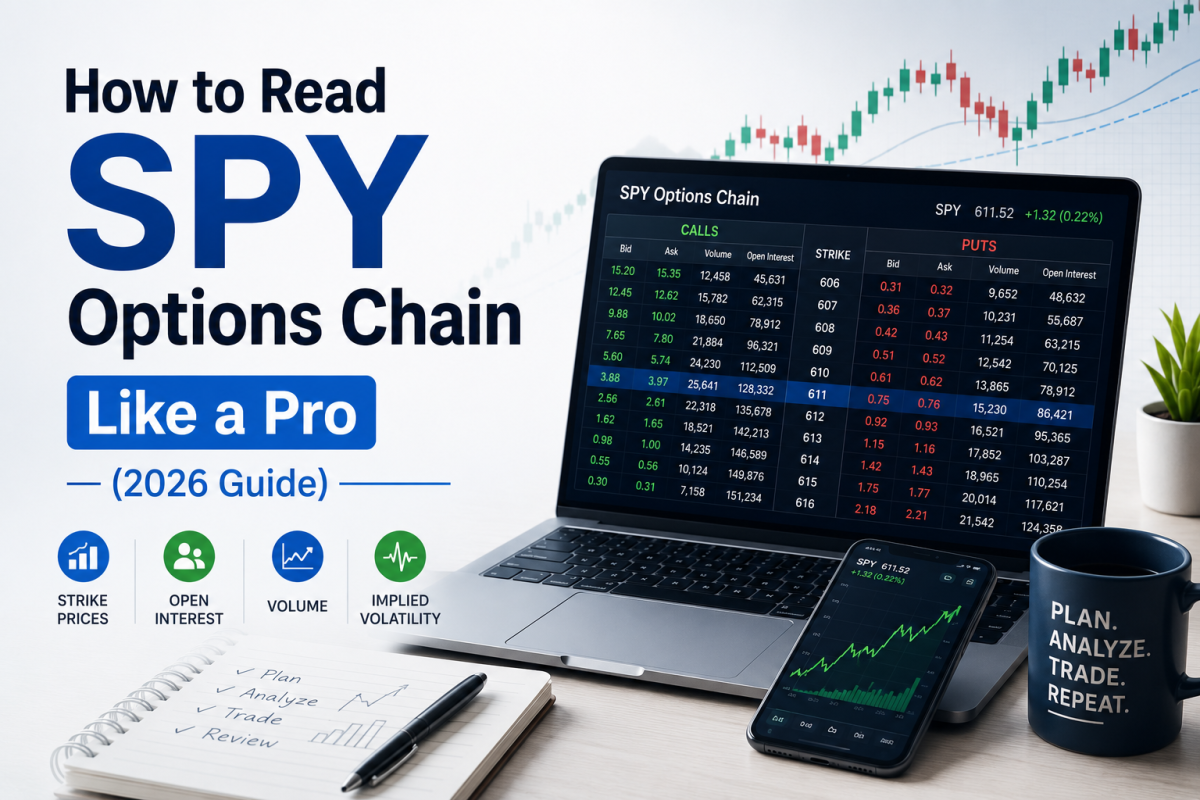
Simply put, an option chain is a table that has all the available call and put options for a particular underlying asset. It shows the following key information:

  • Strike prices
  • Expiration dates
  • Bid and ask prices
  • Last traded price
  • Volume
  • Open interest (OI)

In the US market, option chains are popularly used by traders to make more informed trading decisions, as they are crucial for comparing contracts, analyzing price movements, and deciding entry and exit points.

Key Components of an Option Chain

The key components of an option chain are listed below:

  • Call Options Section – These contain contracts that give you the right to buy the asset.
  • Put Options Section – These contain contracts that give you the right to sell the asset.
  • Strike Price—It is the predetermined price at which you can buy or sell the asset.
  • Expiration Date – It tells you when the option contract expires.
  • Bid Price—It is the highest price buyers are willing to pay for the option.
  • Ask Price—It is the lowest price sellers are willing to accept.
  • Last Traded Price (LTP)—It is the price at which the last transaction occurred.
  • Volume—It is the number of option contracts traded during a given period.
  • Open Interest (OI) – It is the total number of outstanding contracts that have not been settled.

Why Does an Option Chain Matter?

Option chain plays a highly important role in making market decisions because:

  • It provides a quick market overview and helps see all the available options in one table.
  • It helps identify trends, as a high open interest on a certain strike price may be an indication of market sentiment.
  • It helps assess implied volatility before trading.
  • It helps identify the liquidity of an asset using its volume component. High volume indicates active trading and tighter bid-ask spreads.
  • By comparing multiple contracts, one can discover the best risk-reward ratio and make profitable trading decisions that have the least risk.
  • It is essential for planning advanced strategies like straddles, strangles, spreads, and iron condors.

How to Read an Option Chain—Step-by-Step

Want to know how to gain information from an option chain? This is the step-by-step guide:

  • Choose the underlying asset (stock, index, or commodity).
  • Select the expiration date you want to analyze.
  • Review strike prices, i.e., identify at-the-money (ATM), in-the-money (ITM), and out-of-the-money (OTM) options.
  • Compare call and put option prices for your chosen strike.
  • Check open interest and volume to assess liquidity.
  • Utilize the implied volatility component to predict price movements of the asset.
  • Decide on the best contract based on your strategy and risk tolerance.

Real-Life Example of Using an Option Chain

Now, let us look at a practical example of using an option chain and get direct insight into why it is so beneficial.

Suppose there is a stock that is trading at $100. An option chain might show high open interest at the $105 call strike for the upcoming month. What does this signify? This could mean that traders expect the stock to rise, and hence you can buy a call option in accordance with this derived information.


Common Mistakes to Avoid When Reading Option Chains

Now, let’s also understand some commonly seen mistakes that you should avoid while reading option chains.

  • Ignoring open interest: Low OI can make it harder to exit a trade, so you must ensure to pay attention to this component of the option chain.
  • Overlooking bid-ask spread: Wide spreads can increase costs, and disregarding them can lead to unexpected losses in transactions.
  • Not considering implied volatility: High volatility has the power to drastically increase option premiums, and, therefore, these need to be considered before option trading.
  • Choosing the wrong expiration date: Time decay can significantly reduce profits. Therefore, it is important to ensure that you have selected the right expiration.

Pro Tips for Using Option Chains Effectively

All traders can use the following proven tips when utilizing option chains:

  • Focus on liquid contracts having high volume and open interest.
  • Choose a strike price that aligns with your market outlook.
  • Remember to combine option chain data with technical and fundamental analysis while making decisions. This ensures lesser risk and a greater guarantee of profit.
  • Before risking real money, use demo trading platforms to practice reading option chains.


Now, are you all geared up to enhance your trading skills?

Visit MySpyOptions, your trusted trading partner, to receive training, trading tips, and expert market insights right now.

Do not trade blindly—learn to read the option chain and make smarter decisions today!

FAQs

Q1: What is an option chain in simple terms?

An option chain is a list of all the call and put options that are available for a stock, index, or asset. It also has important trading details that help you make safer trading decisions.

Q2: How can I use the option chain to make profits?

US traders use option chains as a very useful tool to increase their profits. It can assist in the analysis of several stock-related factors, including volume, strike prices, and open interest. This leads to a better understanding of market sentiment, which enables you to choose the most profitable contracts.

Q3: Is the option chain only for experienced traders?

No, option chains are meant for all, regardless of whether you  are a beginner or a professional in the US market trading. It is used to understand market trends and plan simple as well as advanced trades.

Q4: Can option chains predict stock prices?

Though the option chain doesn’t predict prices directly, it provides useful insights into market expectations through the transactions and activities of traders. This can give you some clues about stock price changes.

Q5: Does the option chain show implied volatility?

Yes, on several platforms the option chain displays implied volatility, which helps understand potential price movements and risks for the asset in the US market.


Categories
Options Trading Uncategorized

Debit Spread vs Credit Spread: Key Differences Explained

Options trading can be overwhelming, especially when it comes to strategies like spreads. Among the most popular are debit spreads and credit spreads. Both are powerful tools that traders use to control risk, lower costs, and maximize returns. However, they work differently — and knowing when to use debit spread vs credit spread can make a huge difference in your trading success.

In this blog, we’ll break down what debit spreads and credit spreads are, how they work, their pros and cons, and key scenarios where each strategy makes sense.

What is a Debit Spread?

A debit spread is an options strategy where you pay a net premium (cash outflow) to enter the trade.

It usually involves:

  • Buying one option (call or put) with a higher premium, and
  • Selling another option (same type, same expiration) with a lower premium.

Because you’re paying more for the option you buy than you receive for the option you sell, money leaves your account upfront — hence the term “debit” spread.

Example of a Debit Spread (Bull Call Spread)

Suppose Stock XYZ is trading at $100.

  • You buy a call option at $100 strike for $5.
  • You sell a call option at $110 strike for $2.

Your net cost (debit) = $5 – $2 = $3.
That $3 (or $300 per contract) is your maximum loss.

Your maximum gain = Difference between strikes – Net debit = ($10 – $3) = $7.

Hence, risk/reward is defined and favorable if the stock moves upward.

✅ Debit spreads are best when you expect directional moves.

What is a Credit Spread?

A credit spread is an options strategy where you receive a net premium (cash inflow) when entering the trade.

It involves:

  • Selling one option with a higher premium, and
  • Buying another option (same type, same expiration) with a lower premium.

Because you receive more money for the option you sell than you pay for the one you buy, money comes into your account upfront — hence the term “credit” spread.

Example of a Credit Spread (Bear Call Spread)

Stock XYZ is at $100.

  • You sell a call option at $105 strike for $4.
  • You buy a call option at $115 strike for $1.

Your net credit received = $4 – $1 = $3.
That $3 (or $300 per contract) is your maximum profit.

Your maximum loss = Difference between strikes – Net credit = ($10 – $3) = $7.

Hence, your profit is capped, but so is your loss.

✅ Credit spreads are best when you expect limited movement or range-bound trading.

Key Differences Between Debit and Credit Spreads

Feature Debit Spread Credit Spread
Cash Flow at Entry Pay net premium (cash outflow) Receive net premium (cash inflow)
Max Profit Difference between strikes – net debit Net premium received
Max Loss Net premium paid Difference between strikes – net credit
Best For Directional moves (bullish or bearish) Neutral/range-bound markets
Risk Management Lower risk vs outright long options Defined risk with capped returns
Probability of Profit (POP) Lower POP but higher reward-to-risk Higher POP but lower reward-to-risk

When to Use Debit Spreads

You might prefer a debit spread vs a credit spread when:

  • You expect a strong directional move in the stock.
  • You want to limit risk vs buying naked calls/puts.
  • You’re okay with a lower probability of profit but higher upside potential.

Example strategies:

  • Bull Call Spread (bullish)
  • Bear Put Spread (bearish)

When to Use Credit Spreads

You might prefer a credit spread when:

  • You expect the stock to stay within a range.
  • You want to generate consistent premium income.
  • You prefer a higher probability of profit, even with capped returns.

Example strategies:

  • Bull Put Spread (neutral to bullish)
  • Bear Call Spread (neutral to bearish)

Pros and Cons of Debit Spreads

Advantages

  • Limited risk and reward (defined outcomes).
  • Cheaper than buying naked options.
  • Great for directional trades.

Disadvantages

  • Lower probability of profit compared to credit spreads.
  • Time decay (theta) usually works against you.

Pros and Cons of Credit Spreads

Advantages

  • Receive premium upfront.
  • Higher probability of profit.
  • Time decay usually works in your favor.

Disadvantages

  • Limited profit potential.
  • Losses can be bigger than profits if the stock moves against you.

Real-World Example: Choosing Between Debit and Credit Spread

Let’s say you’re analyzing Apple (AAPL) before earnings:

  • If you believe Apple will rally strongly → Debit Spread (Bull Call).
  • If you think Apple will stay flat or not rise much → Credit Spread (Bear Call).

Both approaches have defined risk, but your choice depends on market outlook.

FAQs

Q1: Which is better for beginners — debit or credit spreads?
Debit spreads are usually easier for beginners since they are straightforward directional bets with defined risk.

Q2: Can debit and credit spreads be used together?
Yes. Advanced traders sometimes combine debit and credit spreads into strategies like iron condors or butterflies.

Q3: Do I need a margin account for spreads?
Yes, most brokers require a margin account, especially for credit spreads, since they involve selling options.

Q4: Are debit spreads safer than credit spreads?
Both are defined-risk strategies, but debit spreads limit losses to the upfront premium, while credit spreads can carry higher risk if the stock moves sharply.

Q5: Can spreads be adjusted after opening a trade?
Yes. Traders can roll spreads up/down or out to a later expiration to manage risk or lock in gains.

Final Thoughts

Both debit spreads and credit spreads are essential tools in an options trader’s toolkit. Debit spreads work best for directional bets with limited risk, while credit spreads shine in range-bound markets where traders collect premium income.

If you’re serious about mastering spreads and other advanced strategies, having the right guidance and alerts can save you time and money.

👉 At MySpyOptions, we specialize in helping traders navigate the options market with expert analysis and actionable trade insights. Whether you’re just starting or refining your strategies, we’re here to guide you.

Categories
Options Trading Uncategorized

Theta Decay in Options: How Time Works Against You?

Options trading is all about probabilities, timing, and strategy. Among the most important concepts, traders must understand, is theta decay—the gradual loss of value in an option as it approaches its expiration date.

If you’re new to options trading or looking to refine your strategies, mastering the impact of theta decay can make the difference between making consistent profits or unnecessary losses.

In this article, we’ll understand:

  • What theta decay is and why it matters
  • How it affects call and put options
  • Ways to take advantage of theta decay
  • Strategies to protect yourself from time decay losses

Let’s dive in.

What is Theta Decay in Options?

heta is one of the Greek words that means to measure risk and sensitivity to various factors. Specifically, in options trading, theta measures how much an option’s price decreases with each passing day, everything else being the same.

For example, if an option has a theta of -0.05, it means that the option loses $0.05 in value every day due to time decay.

This is why traders often say, “time is the enemy of the options buyers, but the friend of the options sellers.”

Why Does Theta Decay Happen?

Every option’s price consists of two components:

  1. Intrinsic Value – the actual value if exercised today.
  2. Extrinsic Value (Time Value) – the premium traders are willing to pay for the possibility of the option becoming profitable before expiration.

Theta decay occurs because as expiration approaches, the time value decreases and there is lesser time for the stock to move favorably.

  • Near expiration: time decay accelerates rapidly.
  • Far from expiration: decay is slower and less noticeable.

How Theta Decay Impacts Call and Put Options?

Theta decay doesn’t discriminate—it impacts both calls and puts. However, the effect varies depending on whether you are buying or selling options.

  • Option Buyers → Lose from theta decay. Every passing day chips away the premium they paid.
  • Option Sellers (Writers) → Benefit from theta decay. Every passing day increases the chance they keep the premium.

For example:

  • You buy a call option on a stock trading at $100, paying $5 in premium.
  • As time passes without the stock moving significantly, the option might lose $1–2 purely due to theta decay, even if the stock’s price stays flat.

This is why many traders prefer selling options or using spreads to offset time decay.

When is Theta Decay the Fastest?

Theta decay is non-linear. It accelerates as expiration nears.

  • 30–45 days before expiration → Time decay is moderate.
  • Last 2 weeks before expiration → Decay speeds up dramatically.
  • Final days → Options can lose value very quickly, especially in out-of-the-money contracts.

This is why many experienced traders either close positions early or design strategies specifically to profit from rapid decay.

Strategies to Take Advantage of Theta Decay

If you understand theta decay, you can turn time into your ally. Here are some strategies traders use:

1. Covered Calls

Owning 100 shares of stock and selling a call option against it. The premium you collect benefits from theta decay every day.

2. Cash-Secured Puts

Selling puts on stocks, you wouldn’t mind owning. As time passes, the premium erodes in your favor.

3. Iron Condors & Credit Spreads

Strategies designed to profit from both time decay and low volatility.

These strategies allow traders to “sell time” and profit as each day passes without large stock movements.

How to Protect Yourself From Theta Decay?

If you’re an options buyer, theta decay is your biggest enemy. Here’s how to reduce its impact:

  • Choose Longer Expirations → Options with more time value decay slower.
  • Exit Early → Don’t hold until the last days unless absolutely necessary.
  • Use Spreads → Debit spreads (buy one option, sell another) help offset time decay.
  • Be Strategic with Timing → Only buy options when you expect a big move soon.

Real-World Example of Theta Decay

Let’s say you buy a call option on Apple (AAPL) at $150 strike, expiring in 30 days. The option costs $4.50.

  • Day 1: Stock doesn’t move. Premium drops to $4.30 → Theta decay took $0.20.
  • Day 10: Still flat. Premium drops to $3.60.
  • Day 25: Now only 5 days left. Premium collapses to $1.10 unless AAPL moves strongly.

This is the power of theta decay working against buyers.

Key Takeaways

  • Theta decay is time decay. It leads to the daily erosion of an option’s value.
  • It accelerates as expiration nears, and hits buyers hardest near to expiry.
  • Sellers benefit from theta, while buyers must plan strategically to overcome it.
  • Using spreads, covered calls, or selling puts are ways to profit from theta decay.

FAQs

Q1: Can theta decay ever work in favor of buyers?
Yes. If the underlying stock moves strongly in the expected direction, the gains from delta (price movement) can outweigh the loss from theta decay.

Q2: Does implied volatility affect theta decay?
Yes. Higher implied volatility inflates option premiums, which can temporarily offset time decay. However, as volatility drops, time decay becomes more apparent.

Q3: Which options have the slowest theta decay?
Options with longer expirations (LEAPS) decay much slower compared to near-term contracts.

Q4: Do all options have negative theta?
Not always. Some complex spreads or option-selling strategies can result in positive theta, meaning time decay actually works in your favor.

Final Thoughts

Theta decay is one of the most important concepts in options trading. If you don’t understand how time works against your positions, you risk losing money even when you guess the stock’s direction correctly.

If you want expert guidance on options strategies, risk management, and trade alerts, consider reaching out to MySpyOptions. Our team specializes in helping traders navigate the complexities of the options market with confidence.

Categories
Finance Options Trading

Best Option Trading Platforms in the US: 2025 Edition

In 2025, traders in the US market are looking for speed, tools, and transparency. Why? Because they have discovered that the secret key to successful trades and a stunning trade portfolio is not just the trader’s knowledge and talents, but also the platforms and tools that they use.
Thus, it goes without saying that whether you’re a beginner or a seasoned professional, the right platform can elevate your options strategy. Thus, if you are looking for the best option trading platform in 2025 to add to your arsenal, you are in the right place!
Hence, lets try and find out the best option trading platforms in the US based on reliability, features, pricing, and more.

Best Option Trading Platforms in the US in 2025

TD Ameritrade (Thinkorswim)

TD Ameritrade is one of the most popular option trading platforms in the US, offering advanced charting and strategy tools suited to serious traders. One of the major plus points of this platform is that it has no commission on online option trades and only charges a commission of $0.65 per contract.
In addition to its superior functionalities, TD Ameritrade also has a customizable layout with real-time data feeds, making it a perfect tool for active traders and technical analysts.

Interactive Brokers (IBKR)

IBKR is one of the best option trading platforms in the US and offers ultra-low fees per contract (as low as $0.15–$0.65). Additionally, it has direct market access and offers global reach to its users.
Additionally, IBKR also supports complex, multi-leg options strategies and is a must-have for experienced traders and international investors.

Tastytrade

Tastytrade was designed by options traders and is popular as it charges a simple and flat fee of $1 per leg commission and a maximum of $10 per trade.
With a sleek, intuitive interface, this application offers real-time curve analysis and is one of the best option trading platforms in 2025. The platform is best suited for intermediate to advanced traders and is a definite boon to your options strategies.

Robinhood

Robinhood is one of the popular applications that offers commission-free options trading with a stunning zero contract fees. Additionally, it has a mobile-first interface that is beginner-friendly and easy to use.
This platform requires no minimum deposit from the user and, hence, is perfect for new traders and casual investors.

E*TRADE

The Power E*TRADE platform offers powerful tools to users and provides services with zero commissions. It has a fee of $0.65 per contract that can be reduced to $0.50 for volume traders.
This application is valuable for its educational resources and risk analysis tools, making it one of the best option trading platforms in the US currently. Hence, it is a great platform for traders wanting a balance of power and usability.

Comparison Table of the Best Option Trading Platforms in the US

Platform Fees (per contract) Strengths Best For
TD Ameritrade $0.65 Tools, strategy builder Active traders
Interactive Brokers $0.15–$0.65 Global access, low cost Pros & global investors
Tastytrade $1 per leg (max $10) Options-focused, intuitive UI Serious options traders
Robinhood $0 Easy interface, no fees Beginners
E*TRADE $0.50–$0.65 Analysis tools, education Intermediate traders

How to Choose the Best Option Trading Platform for You?

Looking for the best option trading platform suited to your needs? Look no further! These are a few pointers that you need to consider before selecting a platform from the above list:

  • Consider your experience level: Choose intuitive platforms like Robinhood if you’re a beginner.
  • Assess your trading frequency: Frequent traders may prefer low-cost, high-speed platforms like IBKR.
  • Evaluate tools & resources: Thinkorswim and Power E*TRADE offer deep analytics that could elevate your options strategies.
  • Watch the fees: Even a few cents per contract can add up over time. Hence, do not forget to incorporate platform fees into your profit calculations.

Pro Tips to Maximize Your Options Trading in 2025

Here are some of the best tips that we swear by at MySpyOptions to maximize your options trading in 2025:

  • Use demo accounts to test strategies before risking real capital.
    Stay updated on market volatility. Most platforms offer real-time news alerts, and be sure to pay attention to them.
  • Don’t ignore educational content. Several platforms like E*TRADE provide extensive learning materials that can power your strategies and decisions.
  • Use mobile apps for flexibility, especially during market hours.

Final Thoughts

Remember, the best options trading platform isn’t one-size-fits-all. A variety of trading platforms are available today, and the best five have been listed above. Each of the above-mentioned platforms suits a trader differently depending on your strategy, your budget, and your preferences. Hence, do not forget to consider all these aspects before choosing the best option trading platform suited to your needs.

And, if you are still unsure, you can always start small with a demo or paper trading account to figure out your financial plans and your ideal platform.

Ready to take your options trading to the next level? Then, you need to combine the best options trading platform with the best strategies. And this is where MySpyOptions comes to your rescue!

MySpyOptions: Your Trading Advantage

Even with the best platform for option trading, trading without a plan can lead to heavy losses. This is where MySpyOptions comes to your rescue!

MySpyOptions helps you:

  • Trade using a proven rule-based system learned through our effective training techniques.
  • Learn when to enter/exit with precision using our timely alerts.
  • Avoid emotion-based, hasty decision-making that can lead to harmful choices.

Whether you’re using TD Ameritrade, E*TRADE, or IBKR, our alerts are designed to be platform-independent and tailored to your needs.

So, what are you waiting for? Join MySpyOptions and make smarter trades with smarter tools—start today!

FAQs

Q1. Which options trading platform is best for beginners?

The best option trading platform for beginners is Robinhood due to its zero-fees policy and simple interface.

Q2. What’s the cheapest options trading platform?

One of the best option trading platforms that offers ultra-low fees is Interactive Brokers. This platform charges as low as $0.15 per contract.

Q3. Which platform has the best tools?

TD Ameritrade’s Thinkorswim is the best option trading platform that is packed with pro-level tools.

Q4. Can I trade options on mobile?

Absolutely! All the best option trading platforms listed above—TD Ameritrade, Interactive Brokers, Tastytrade, Robinhood, and E*TRADE—offer full-featured mobile apps and allow options trading through them.

Q5. Are these platforms regulated?

Yes, all the best option trading platforms listed above—TD Ameritrade, Interactive Brokers, Tastytrade, Robinhood, and E*TRADE—are FINRA and SEC regulated for US-based traders.

Categories
Finance Options Trading

Options Trading with Technical Analysis: What You Should Know

Options trading can be a powerful tool for investors who want to manage risk, generate income, or speculate on market movements. However, like any form of trading, success often depends on timing and strategy. That’s where options trading technical analysis comes into play.

In this guide, we’ll break down how options trading technical analysis works, which tools and indicators are most useful, and how you can start using it to make more informed trading decisions.

What Is Options Trading Technical Analysis?

Options trading technical analysis is the study of past market data, primarily price and volume, to forecast future price movements. Unlike fundamental analysis—which focuses on a company’s financials, management, and market position—technical analysis is concerned with price patterns, trends, and indicators.

In options trading, this approach helps traders decide:

  • When to enter a trade
  • When to exit a trade
  • Which strike price and expiry to choose

Why Options Trading Technical Analysis Is Crucial for Traders

Options are time-sensitive instruments. Their value is influenced by factors such as volatility, underlying price movements, and time decay (theta). Technical analysis helps traders:

  • Identify support and resistance levels
  • Gauge market momentum
  • Predict short-term price action
  • Avoid emotional decision-making

With technical signals, traders can better time their positions and select more profitable option contracts.

Top Technical Indicators for Options Trading

Here are the most widely used indicators that options traders rely on:

1. Moving Averages (MA)

  • Simple Moving Average (SMA) and Exponential Moving Average (EMA) help identify the trend.
  • Useful for spotting crossovers and confirming breakouts.

2. Relative Strength Index (RSI)

  • Measures the magnitude of recent price changes.
  • Helps spot overbought or oversold conditions—ideal for timing entries in directional options trades.

3. Bollinger Bands

  • A volatility indicator that shows when prices are stretched.
  • Useful for identifying potential reversals or breakouts.

4. MACD (Moving Average Convergence Divergence)

  • Combines trend-following and momentum.
  • Helps confirm entries and exits, particularly in swing trades.

5. Volume Indicators

  • Confirm the strength of a price move.
  • High volume often signals institutional activity and helps validate breakouts.

Options Trading Technical Analysis Strategies forTraders

Here’s how you can apply technical analysis to actual trading strategies:

1. Buying Call or Put Options on Breakouts

  • Identify breakout levels using horizontal resistance/support.
  • Use volume confirmation to validate the breakout.
  • Choose a strike price near the current level and an expiration that allows enough time for follow-through.

2. Selling Options at Support/Resistance Zones

  • If a stock is near resistance, consider selling a call.
  • If near support, consider selling a put.
  • Time decay (theta) works in your favor if the stock stays within range.

3. Using RSI Divergence

  • If price makes a new high but RSI does not, it could signal a reversal.
  • Great for timing credit spreads or debit spreads.

4. Iron Condors Based on Range-Bound Indicators

  • Use Bollinger Bands and RSI to identify tight trading ranges.
  • Sell an iron condor with strike prices outside the bands.

Risk Management and Technical Analysis

Even the best options trading technical analysis can’t predict the future with certainty. That’s why risk management is essential.

Best practices include:

  • Never risk more than 1–2% of your account on a single trade.
  • Set stop-losses and profit targets.
  • Use technical levels to define risk and reward.
  • Avoid trading solely based on one indicator—look for confluence.

Common Mistakes in Options Trading Technical Analysis

  1. Overfitting Indicators: Using too many indicators can create confusion.
  2. Ignoring the Greeks: Options Trading Technical analysis should be combined with an understanding of delta, theta, and implied volatility.
  3. Chasing Trades: Entering late after a signal is already played out leads to poor risk/reward setups.
  4. Lack of Backtesting: Before using any indicator, backtest your strategy.

Final Thoughts: Combining Technical Analysis with Options Trading

When used correctly, options trading technical analysis gives options traders a structured approach to read the market. It can improve timing, enhance probability, and help avoid emotional pitfalls. Whether you’re selling credit spreads or buying directional calls, technical tools should be part of your trading plan.

Want to Practice Before Going Live?

To master technical analysis in options, practice is key. Use paper trading platforms or simulators to test strategies without risk.

Explore Smarter Options Trading with MySpyOptions

If you’re serious about learning and applying options trading technical analysis, MySpyOptions offers insightful tools, trading resources, and real-time support to help you trade smarter. Join our platform to access strategies, signals, and educational content built for traders at all levels.

Categories
Finance Options Trading

Trading Stocks for Beginners: A Simplified Learning Path

Introduction: The First Step into the World of Stock Trading

Trading stocks for beginners can seem overwhelming at first. Financial news, market tickers, and complex charts may look intimidating to a beginner. However, learning to trade stocks doesn’t have to be complicated. With the right guidance and tools, anyone can begin his/her journey towards understanding and participating in the stock market.

This guide offers a simplified, structured approach to trading stocks for beginners, breaking down concepts into digestible steps.

What Is Stock Trading?

At its core, stock trading involves buying and selling shares of publicly traded companies. When you purchase a share, you own a small portion of that company. Traders aim to buy low and sell high, profiting from the price difference.

There are two primary types of stock trading:

  • Long-term investing (buy-and-hold)
  • Short-term trading (active trading or day trading)

While both involve buying and selling stocks, trading often focuses on short-term price movements.

Understanding the Stock Market Basics

Before you begin trading, it’s essential to grasp how the stock market functions:

  • Stock Exchanges: The main platforms where stocks are bought and sold (e.g., NYSE, NASDAQ).
  • Stock Brokers: Intermediaries that facilitate trades for retail traders.
  • Trading Platforms: Online tools or apps provided by brokers to execute trades.

Key terms to know:

  • Ticker symbol: A unique set of letters representing a stock (e.g., AAPL for Apple).
  • Bid/Ask Price: The price buyers are willing to pay vs. the price sellers ask.
  • Spread: The difference between the bid and ask prices.

Types of Stock Traders

Before you dive in, identify your trading style:

  • Day Traders: Buy and sell stocks within the same trading day.
  • Swing Traders: Hold stocks for days or weeks to profit from short-term price swings.
  • Position Traders: Take long-term positions based on broader market trends.
  • Scalpers: Make dozens of trades per day, seeking small profits per trade.

As a beginner, swing trading or long-term investing tends to be more manageable.

Setting Up a Trading Account

To begin trading:

  • Choose a reliable online brokerage that offers:

    • User-friendly platforms
    • Low fees or commission-free trading
    • Educational resources
  • Submit your KYC (Know Your Customer) information.
  • Fund your account using a bank transfer or payment gateway.

Popular platforms for beginners include Fidelity, Charles Schwab, TD Ameritrade, and Robinhood.

Learn to Read Stock Charts

Charts provide insights into a stock’s price movement. The most common chart types:

  • Line Chart: Shows closing prices over a period.
  • Candlestick Chart: Displays opening, closing, high, and low prices for a given time period.

Candlestick patterns help traders understand momentum and reversal signals, however, they require practice.

Start with a Virtual Trading Account

As a beginner, it’s wise to use paper trading platforms or demo accounts to practice without risking real money.

These simulators mirror real market conditions and help you:

  • Understand how orders work (market, limit, stop-loss)
  • Test strategies in real-time
  • Build confidence before going live

Master Risk Management

One of the most important lessons in trading stocks for beginners is risk management. Even the most experienced traders lose money sometimes.

Key practices include:

  • Never risk more than 1-2% of your capital on a single trade.
  • Use stop-loss orders to limit potential losses.
  • Diversify across sectors and industries.

By managing risk effectively, you protect your capital and stay in the game longer.

Develop a Trading Strategy

A strategy defines how you choose stocks, when you buy, and when you sell.

Common beginner strategies:

  • Breakout Trading: Buying when a stock moves above a resistance level.
  • Trend Following: Trading in the direction of a strong upward or downward trend.
  • Moving Averages: Using average price indicators to determine entry/exit points.

Whatever strategy you choose, test it first and refine it over time.

Stay Informed with News and Analysis

Markets are driven by economic news, earnings reports, and global events.

Stay updated with:

  • Financial news websites (e.g., CNBC, Bloomberg, Yahoo Finance)
  • Stock screeners and analysis tools (e.g., Finviz, TradingView)
  • Market calendars for earnings announcements and major events

Information is power—especially in stock trading.

Common Mistakes Beginners Make (And How to Avoid Them)

  • Overtrading: Making too many trades out of emotion or boredom.
  • Chasing the market: Jumping into stocks because they’re suddenly rising.
  • Ignoring fees: Commissions or hidden charges can erode your profits.
  • Lack of a plan: Trading without a defined goal or system leads to losses.

Be disciplined, patient, and consistent with your approach.

Conclusion: Begin with Confidence, Learn Continuously

Trading stocks as a beginner can be a rewarding journey if approached with the right mindset and tools. Start slow, focus on learning, and avoid the urge to “get rich quick.” Over time, your experience and knowledge will help you make informed decisions in the market.

A Smarter Way to Learn & Practice

If you’re ready to put your trading skills to the test safely, consider using platforms that offer real-time simulations and market insights. At MySpyOptions, we simplify the learning process and empower you to trade smarter—whether you’re just starting or building your experience.

Categories
Finance Options Trading

How to Practice Day Trading Without Risking Real Money ?

Day trading is an exciting and fast-paced approach in the stock market, where positions are bought and sold within the same trading day. While the potential for profits is high, there is an increased risk as well—especially for beginners. Fortunately, there are safer ways to practice day trading without risking any real money. If you’re serious about learning how to practice day trading, this guide will walk you through the best methods, tools, and tips to get started.

What Is Day Trading?

Before diving into how to practice day trading, it’s important to understand what day trading entails. Day trading involves buying and selling financial instruments such as stocks, ETFs, forex, or crypto within a single trading day. The goal is to capitalize on small price movements using technical analysis, news, and fast decision-making.
Unlike long-term investing, day trading requires precision, a strong grasp of market behavior, and disciplined risk management. Hence, it is essential to practice before committing real funds.

Why Practice Day Trading?

Day trading is a skill-based activity. Even if you have a solid understanding of financial markets, trading in real-time is a completely different experience. Here’s why practicing before going live is crucial:
Avoid Losses: The majority of new day traders lose money. Practicing allows you to learn from mistakes without financial consequences.

Build Confidence: Practicing helps you become familiar with trading platforms and strategies so you can execute with confidence.

Understand Market Mechanics: You get a better grasp of how orders are filled, how volatility affects trades, and how to manage time-sensitive decisions.

Refine Strategy: Simulation allows you to test strategies and refine them based on results.

1. Use Paper Trading Accounts

Still unsure of how to practice day trading? The most common and beginner-friendly way to practice day trading is through paper trading, also known as simulated trading. Many brokers and trading platforms offer this feature, allowing users to place trades with virtual money in real-time market conditions.
Best Paper Trading Platforms:
Thinkorswim by TD Ameritrade – Offers advanced tools and realistic simulations.

TradingView – Allows chart-based paper trading with real-time data.

Webull – Provides a paper trading option within its platform.

NinjaTrader – Good for futures and forex practice.

Investopedia Simulator – Educational and easy to use for beginners.

These platforms mimic real markets, letting you experience order execution, price movement, and position management without financial risk.

2. Use Demo Accounts from Brokers

Many forex and stock trading brokers offer demo accounts for free. Unlike paper trading that uses static prices or delays, demo accounts often use real-time data. This provides a more accurate experience and is ideal for practicing day trading in fast-moving markets.
Demo accounts also introduce you to the broker’s interface, fees, and available trading tools, helping you decide which platform suits you best.

3. Track Your Trades and Performance

Practicing is only effective if you analyze your results. Maintain a trading journal to track:
The strategy used

Entry and exit points

Profit or loss per trade

What worked and what didn’t

This journal will help you identify patterns and consistently improve. Many paper trading platforms automatically provide trade history, but documenting your reasoning and psychology behind trades can be just as important.

4. Simulate Realistic Trading Conditions

Practicing should mirror real-life trading conditions as closely as possible. That includes:
Using realistic capital: Don’t simulate with $1 million if you plan to trade with $5,000. Practice with the same amount you’ll eventually use.

Setting realistic position sizes: Avoid overly large positions that wouldn’t fit your actual trading plan.

Respecting market hours: Trade during normal trading hours, especially if you’re focused on stocks or ETFs.

It is important to note that the habits you build in practice carry over seamlessly into live trading.

5. Learn Technical Analysis

Day trading relies heavily on technical analysis. During practice, familiarize yourself with:
Candlestick patterns

Chart indicators (MACD, RSI, Bollinger Bands, etc.)

Volume analysis

Support and resistance levels

Moving averages

These tools help predict short-term price movements, which is key to successful day trading.

6. Test Multiple Trading Strategies

Practicing is essential to experiment with different trading strategies and see what fits your style and risk tolerance. Some popular day trading strategies include:
Scalping: Making dozens of trades for small profits.

Momentum Trading: Trading based on price strength and volume surges.

Reversal Trading: Betting on price reversals after a strong trend.

Breakout Trading: Entering positions as prices move beyond key levels.

Simulated trading lets you test each strategy under different market conditions to find the most effective one.

7. Watch the Market Daily

Even if you’re not trading real money, develop the habit of observing the market daily. Notice:
How news impacts prices

Typical daily volume patterns

Sector rotations

Economic data releases and their effects

These help build your market intuition—an essential skill for successful traders.

8. Join Day Trading Communities

Engaging with other traders can accelerate your learning. Many online forums and social communities offer real-time insights, strategy discussions, and trade recaps. Consider joining:
Reddit’s r/Daytrading

StockTwits

Discord or Telegram groups focused on trading

YouTube channels from professional traders

However, always verify the credibility of shared strategies before applying them.

9. Read Books and Take Courses

In addition to practical simulation, build your theoretical foundation. Some recommended books for aspiring day traders include:
“How to Day Trade for a Living” by Andrew Aziz

“A Beginner’s Guide to Day Trading Online” by Toni Turner

“Technical Analysis of the Financial Markets” by John J. Murphy

Many platforms also offer structured courses that cover trading psychology, strategy, and risk management.

10. Transition to Live Trading Slowly

Once you’ve practiced consistently and refined your strategy, consider moving to a live account. However, start small—use a micro account or trade with minimal capital until you’re confident.
Even the best practice environment can’t prepare you for the emotional aspect of losing real money. By easing into live trading, you reduce the risk of significant losses and avoid psychological burnout.

Common Mistakes to Avoid While Practicing

Overtrading: Don’t place trades just for the sake of it.

Ignoring stop-loss rules: Always simulate with risk management in place.

Not tracking trades: Without a journal or review, progress will be slow.

Switching strategies too frequently: Give some time to each method before moving on.

Using unrealistic account sizes or leverage: This will not reflect real-world conditions.

Final Thoughts

Learning how to practice day trading without risking real money is the smartest way to enter the world of active trading. With the right tools, mindset, and discipline, you can develop your skills and confidence before placing a live trade. Use simulation platforms, keep a detailed trading journal, and focus on consistent improvement.
Day trading can be both rewarding and risky, but a well-practiced trader is far more likely to succeed. Treat your practice phase with the same seriousness as real trading, and you’ll be much better prepared when you decide to trade with actual capital.
If you’re looking for actionable trading insights, educational resources, and tools to support your trading journey, MySpyOptions is here to help. Explore our blog for strategies, tips, and updates to sharpen your trading edge—whether you’re just starting out or looking to take your skills to the next level.

Categories
Finance Options Trading

Can You Buy and Sell Stocks the Same Day?

Yes, you can buy and sell stocks the same day. This practice is commonly known as same-day trading or intraday trading. Many traders engage in this strategy to take advantage of short-term price movements. However, there are specific rules, risks, and considerations that you must understand before participating in this form of trading.

This blog explains everything you need to know to buy and sell stocks the same day, including the regulations, types of accounts, and best practices to follow if you are new to trading.

What Is Same-Day Trading?

Same-day trading refers to the process of purchasing and selling a stock within the same trading day. The trader opens and closes a position before the market closes. The goal is to make a profit from small price fluctuations during the trading session.

For example, a trader may buy 200 shares of a stock at 10:00 AM and sell them at 2:00 PM if the price rises. This transaction qualifies as a same-day trade. It differs from swing trading or long-term investing, where stocks are held for days, weeks, or months.

Types of Accounts Used in Same-Day Trading

There are two primary types of brokerage accounts traders use to buy and sell stocks the same day: cash accounts and margin accounts. Each has its own set of rules and limitations.

Cash Account: In a cash account, you trade using the money that has already been settled in your account. You can buy and sell stocks on the same day, but you must wait for the trade to settle (usually two business days) before you can reuse the proceeds.

Margin Account: A margin account allows you to borrow funds from your broker to buy securities. While it offers more flexibility, it is also subject to strict regulations, particularly the Pattern Day Trader (PDT) rule.

Understanding the Pattern Day Trader Rule

The Pattern Day Trader (PDT) rule is a regulatory measure designed to protect retail traders from excessive risk. If you execute four or more day trades within five business days using a margin account, you will be flagged as a pattern day trader.

Once this designation is applied, your brokerage account must maintain a minimum balance of $25,000 to continue same-day trading. If your balance falls below this amount, your broker may restrict your trading activity or issue a margin call.

Key Points About the PDT Rule:

  • Applies only to margin accounts
  • Minimum balance requirement is $25,000
  • Violating the rule can result in account restrictions

Can You Avoid the PDT Rule?

Yes, you can avoid the PDT rule by using a cash account instead of a margin account to buy and sell stocks the same day. However, trading in a cash account means you can only use settled funds. This limitation restricts your ability to execute multiple trades in a short period but helps you avoid regulatory scrutiny.

Another alternative is to reduce the number of day trades you make. As long as you execute fewer than four day trades within five business days, the PDT rule does not apply.

Benefits of Same-Day Trading

Same-day trading offers several advantages for those who understand the markets and have a disciplined trading strategy.

Quick Turnaround: Same-day trading allows you to make profit from short-term price movements without holding positions overnight, which can expose you to after-hours market risks.

Active Market Engagement: Traders can stay engaged with the markets and respond quickly to news, earnings reports, and economic data that influence stock prices.

Potential for Daily Profits: While long-term investing requires patience, day trading can potentially generate income on a daily basis, depending on market conditions and trading skills.

Risks of Same-Day Trading

Despite its potential benefits, same-day trading also carries significant risks.

High Volatility: Stocks can move quickly and unpredictably, especially during earnings season or breaking news. When you buy and sell stocks the same day, a small misstep can lead to substantial losses.

Emotional Stress: Constant decision-making and market monitoring can be mentally exhausting, leading to poor judgment and impulsive trades.

Financial Risk: Trading with leverage in a margin account can amplify losses. Even a small price drop can result in margin calls or account liquidation.

Commissions and Fees: Frequent trading may lead to higher commissions and fees, especially with brokers that do not offer commission-free trading.

Best Practices for Same-Day Trading

If you are considering same-day trading, it is important to follow certain best practices to manage risk and improve your chances of success.

Start with a Simulated Account: Most brokers offer demo or paper trading accounts that allow you to practice trading without risking real money. This is an excellent way to gain experience.

Set Realistic Goals: Focus on small, consistent gains rather than aiming for large profits. Day trading requires discipline and a clear plan.

Use Stop-Loss Orders: Protect your capital by setting stop-loss levels. This ensures you exit a trade if it moves against you.

Limit the Number of Trades: Overtrading can lead to emotional fatigue and increased risk. Choose your trades carefully and avoid forcing opportunities.

Stay Informed: Keep up with market news, earnings reports, and economic indicators that may affect stock prices.

Common Strategies for Same-Day Trading

Several strategies are commonly used in same-day trading. Each requires a unique set of skills and market analysis.

Momentum Trading: Traders look for stocks that are moving significantly in one direction on high volume. The goal is to ride the trend until signs of reversal appear.

Scalping: This strategy involves making multiple trades throughout the day to capture small price movements. Profits are made on volume and frequency.

Breakout Trading: Traders enter positions when a stock breaks through established support or resistance levels, expecting a continuation in the same direction.

Reversal Trading: In this approach, traders look for signs that a stock is about to reverse its current trend, aiming to make profit from the change in direction.

Technical Tools for Same-Day Trading

To be successful in same-day trading, you need access to real-time data and analytical tools. Some of the most commonly used tools include:

Charts and Indicators: Use candlestick charts and indicators like Moving Averages, RSI (Relative Strength Index), and MACD (Moving Average Convergence Divergence) to make informed decisions.

Level II Quotes: Provides insight into supply and demand by showing real-time bids and asks for a stock.

News Feeds: Timely news updates can help you respond quickly to market-moving events.

Economic Calendars: Track scheduled economic reports and announcements that may affect the markets.

Summary Table: Same-Day Trading Overview

Topic Key Takeaways
Is it legal? Yes, same-day trading is permitted
PDT Rule Applies to margin accounts with 4+ trades in 5 days
Account Types Cash and Margin
Benefits Quick profits, no overnight risk, active trading
Risks High volatility, emotional stress, potential losses
Tools Real-time charts, indicators, news feeds
Strategies Momentum, scalping, breakout, reversal

Conclusion

Buying and selling stocks on the same day is entirely possible and can be a profitable strategy if done correctly. However, it has its own challenges. Understanding the rules, especially those related to account types and the Pattern Day Trader designation, is crucial.

If you are new to trading, and if you plan to buy and sell stocks the same day, it is advisable to begin with a small account, use a demo platform, and focus on learning and discipline rather than immediate profits. With the right mindset and preparation, same-day trading can be a valuable part of your overall trading approach.

Categories
Finance

Call Option vs Put Option: Key Differences and When to Use

New to the options world? Calls and Puts are confusing you? Then, you have landed exactly where you should be!

Call and Put options are two primary instruments of options trading that give traders the flexibility to speculate, hedge, or leverage market positions. Understanding the core idea of put vs call options is essential for any options trader, whether novice or experienced, to master the US market. Identifying their differences and the right time to use them could mean the difference between safe trading and risky market investment.

So, let us get right into it!

What is a Call Option?

A call option gives the buyer the right to buy an asset at a specified price within a certain time. This specified price is often referred to as the strike price in the US market, and we use this option when we expect the price of the target asset to rise in the future, but within the given time period. 

Though this option gives you the right to buy the asset, it is not an obligation and thus does not force you to buy it under unwanted circumstances. This option is ideal for bullish market scenarios and helps you remain in a safe zone when it comes to buying assets. A premium is required to be paid to acquire this right to buy.

What is a Put Option?

In contrast to the call option, a put option gives the buyer the right to sell an asset at a specified price within a set time period. This option is also not an obligation, thus ensuring that you do not sell your assets at a loss.

This option is used when you expect the price of the target asset to fall in the given time period and keeps you safe from selling your assets at a lower price. This option is ideal for bearish market scenarios and ensures you do not lose the value of your assets. A premium is required to be paid to acquire this right to sell.

Call Option vs Put Option: Key Differences

Aspect Call Option Put Option
Basic Definition Right to Buy Right to Sell
Profit When Prices go up Prices go down
Buyer’s Expectation Expects the market to rise Expects the market to drop
Profitability Behavior Profits when asset value increases Profits when asset value decreases
Risk/Reward Profile Gains if price rises above strike + premium Gains if price falls below strike − premium
Premium Pricing Influenced By Market sentiment & volatility Market sentiment & volatility


When to Use Call Options

Call options are generally used when:

  • You expect the stock price to rise significantly or spike in a short term.
  • You’re bullish on a stock/index such as SPY or QQQ.
  • You want to limit risk while taking a position on price increase.
  • You want to leverage capital with limited downside, i.e., without buying the asset outright.
  • You’re trading with strategies like covered calls or bull call spreads.
  • You’re targeting quick profits from market rallies.

When to Use Put Options

Put options are generally used when:

  • You believe the price will decline soon or expect the asset price to decline sharply.
  • You’re bearish on a stock/index such as SPY or QQQ.
  • You want insurance on a long stock position (this is called a protective put).
  • You’re implementing strategies like bear put spreads or long puts.
  • You want to protect or hedge your portfolio against downturns.
  • You want to take advantage of high volatility on the downside.

Real-World Example: SPY Options Strategy

At MySpyOptions, we specialize in both SPY and QQQ stock options alerts. For the current scenario, let us focus on SPY options to understand how Call and Put options work in practice.

  • Call Example: SPY is trading at $500. You will buy a SPY 500 Call Option if you expect the S&P 500 ETF to rise above $500 soon. If SPY rises to $510, your call increases in value.
  • Put Example: SPY is at $500. You will buy a SPY 500 Put Option if you expect it to fall below $500 in the near term. If SPY falls to $490, your put gains value.
  • Strategy Tip: MySpyOptions alerts help identify the best entry and exit points for both calls and puts.

Summary: Puts vs Calls

Let’s recap the core idea behind put vs call options:

  • Use a call option when you’re bullish.
  • Use a put option when you’re bearish.
  • Both options offer limited risk and unlimited potential, depending on market moves.
  • Smart traders use a mix of call and put options to build flexible strategies.
  • Whether it’s call v put, mastering the timing is key, and that’s exactly what we help you do at MySpyOptions.

Why Choose MySpyOptions for Trading Calls and Puts?

  • We are specialized in SPY and QQQ options alerts and provide highly accurate and timely alerts.
  • We provide training in options trading personalized to your needs to help you trade smarter. We have two plans currently: Stocks & Stock Options Training and Premium Options Training that cover SPY and QQQ and other funds.
  • We have been in this industry for 15+ years and have built a community of over 1000 traders and a very strong expert team.
  • We provide easy-to-understand, beginner-friendly explanations on call and put options to novice traders.
  • We provide expert guidance for strategies around real-world put vs call options and will support you in real-time during live market hours.
  • You will be able to access actionable alerts with detailed entry, exit, and stop-loss points.

Ready to Master Puts and Calls?

Don’t just trade blindly. Understand the difference between a call option vs put option, and trade with confidence.

Start your journey today with MySpyOptions.com!

  •  Accurate SPY alerts
  •  Smart call and put trading strategies
  •  Learn, trade, and win with confidence!

FAQs

 Q1. What’s the difference between call v put options?

The essential difference between calls and puts is that a call is a right to buy, and a put is a right to sell.


Aspect Call Option Put Option
Basic Definition Right to Buy Right to Sell
Profit When Prices go up Prices go down
Buyer’s Expectation Expects the market to rise Expects the market to drop
Profitability Behavior Profits when asset value increases Profits when asset value decreases
Risk/Reward Profile Gains if price rises above strike + premium Gains if price falls below strike − premium
Premium Pricing Influenced By Market sentiment & volatility Market sentiment & volatility


Q2. Which is safer – call or put?

Both calls and puts are equally risky, but they are beneficial as they offer limited losses (premium paid). In many scenarios, several traders prefer puts as they can spike in value faster during downturns.

Q3. Can I use both calls and puts together?

Yes, you can use both Call and Put options together with strategies like straddles or strangles. Smart traders use a mix of call and put options to build flexible strategies.

Q4. Are calls or puts better for beginners?

Calls are easier for beginners to understand in rising markets when compared to Puts. However, Puts are extremely beneficial as they are excellent for hedging or bearish plays, especially during market corrections.

Q5. How do I choose between a call and a put?

To choose between a Call and a Put, refer to the following pointers:

Choose a call if you expect the asset’s price to go up.
Choose a put if you expect the price to drop.
Look at market trends, technical analysis, and MySpyOptions alerts for smart decision-making.


Categories
Finance

Top 5 Best Brokers for Options Trading in the US [2025 List]

Looking to maximize your returns and build an impressive trading profile? Then, you have come to the right place!

As a trading alerts and training partner in the industry for 15+ years, we can tell you that choosing the best broker for option trading in the US is one of the most important decisions you’ll ever make. It can significantly impact your profits, expenses, and overall trading experience by providing you with the best and reliable platforms, order execution speed, efficient commission structures, and multiple trading tools.

Furthermore, if you are a SPY and QQQ options trader, then the broker becomes all the more important. Broker choice is particularly critical for fast execution and low commissions in these types of options.

At MySpyOptions, we help traders make smart trades with precision alerts and expert-led training. In this 2025 guide, we’ll analyze who the best broker for option trading in the US is and why, based on comparison on fees, tools, mobile platforms, and customer support.

So, let’s dive right in!

What to Look for in the Best Broker for Option Trading?

Whether you’re a beginner or an advanced trader, having the right broker can do wonders and can give you quality trading returns. If you are wondering how to rate brokers and what is most important, let us guide you through the necessary checkpoints:

  • Low commissions and contract fees
  • Fast and reliable order execution, which is essential for day/swing trading
  • Strong mobile or desktop trading platform
  • Advanced tools for analyzing options chains and strategies
  • Integration with services like MySpyOptions
  • Paper trading or demo accounts for practice
  • Excellent customer support and funding options

Now, let us compare the 5 best brokers for option trading in the US and find out why they are the top players in this highly competitive and tech-driven space.


Top 5 Best Brokers for Option Trading in the US

1. Tastytrade—Best for Active Options Traders

  • Flat $1.00 per contract (max $10 per leg, free to close trades)
  • Built-in strategy tools: spreads, iron condors, straddles
  • Great UI and educational content for active options traders
  • Fast execution—perfect for SPY/QQQ scalping or day trades.
  • No platform or inactivity fees

2. TD Ameritrade (Thinkorswim)—Best for Analytics

  • $0 commission + $0.65 per contract
  • The Thinkorswim platform offers advanced charting, Greeks, and scanners.
  • Free paper trading with real market data
  • Ideal for using MySpyOptions alerts with real-time charts
  • Easy to scale from beginner to advanced trading levels.

3. Interactive Brokers—Best for Low Fees & Professional traders

  • Tiered pricing: as low as $0.15 to $0.65 per contract
  • Supports complex multi-leg orders and global market access.
  • Professional-level risk and margin analytics
  • Direct routing is available for custom order execution.
  • Best for high-frequency SPX, NDX, and index options traders


4. E*TRADE—Best broker for option trading for Beginners & All-Round Use

  • $0 base commission + $0.65 per contract (drops to $0.50 for 30+ trades/month)
  • Clean mobile and web platform
  • StrategySEEK and other tools for identifying trade setups
  • Excellent customer service and educational resources
  • Great fit for new MySpyOptions subscribers


5. Charles Schwab—Best for Long-Term Options Investors

  • $0 commissions + $0.65 per contract
  • Great for conservative, longer-term SPY/QQQ trades
  • Simplified interface with enough tools for basic strategies
  • Schwab’s acquisition of TD means access to Thinkorswim soon.


 Comparison Table

Broker Contract Fee Best For Key Tools/Features
Tastytrade $1.00 Active strategy traders Built-in strategy tools and other options
TD Ameritrade $0.65 Chart-based decision making Thinkorswim analytics & paper trading
Interactive Brokers $0.15–$0.65 Professionals, low-fee seekers Global access, custom routing
E*TRADE $0.65 ($0.50) Beginners & swing traders StrategySEEK, clean UI
Charles Schwab $0.65 Long-term investors Simple platform, low fees


Tips to Choose the Right Broker for You

  • If you’re trading daily with complex spreads, choose Tastytrade or Interactive Brokers.
  • If you rely on chart analysis, TD Ameritrade (Thinkorswim) is your best pick.
  • If you’re new to options, go with E*TRADE for a smoother experience.
  • If you’re managing a retirement or long-term account, choose Charles Schwab.
  • Remember to always pair your broker with MySpyOptions alerts and training to execute smarter trades.


How MySpyOptions Fits in With These Brokers

MySpyOptions is not a broker—it’s your go-to platform for premium training and alerts. However, we fit in with any of the above brokers to execute trades based on our SPY/QQQ alerts.

We provide:

  • Real-time, rule-based alerts for SPY, QQQ, and other index options
  • Structured 15-day premium training on a proven 5-step system
  • Three months of live market mentorship and alert support

No matter which broker you choose, MySpyOptions helps you trade with clarity and confidence.


MySpyOptions: Your Trading Advantage

Even with the best broker for option trading, trading without a plan can lead to heavy losses. This is where MySpyOptions comes to your rescue!

MySpyOptions helps you:

  • Trade using a proven rule-based system learned through our effective training techniques.
  • Learn when to enter/exit with precision using our timely alerts.
  • Avoid emotion-based, hasty decision-making that can lead to harmful choices.

Whether you’re using TD Ameritrade, E*TRADE, or IBKR, our alerts are designed to be broker-independent and tailored to your needs.


Looking to combine the best broker with the best strategy?

Join MySpyOptions to get expert SPY/QQQ options training and real-time alerts.

Start trading smarter—no matter which broker you choose.


FAQs

Q1. Is MySpyOptions a broker?

No. MySpyOptions is an alert and training service. As a trader, you’ll need a separate broker to place trades. MySpyOptions provides you with live-market alerts and expert-led training.

Q2. Which broker works best with MySpyOptions alerts?

Any US-based broker with fast execution—Tastytrade, TD Ameritrade, Interactive Brokers, or E*TRADE—work with MySpyOptions alerts. No matter which broker you prefer to use, our alerts can always be paired with them, as they are designed to be broker-independent and optimized to your needs.

Q3. What’s the cheapest options broker in 2025?

Currently, Interactive Brokers offers the lowest per-contract fees, especially for high-volume traders. Therefore, they can be termed the cheapest options broker in 2025.

Q4. Can beginners use these brokers?

Yes, beginners can definitely make use of these brokers to enhance their trading profile and elevate their returns. E*TRADE and Schwab are especially beginner-friendly.

Q5. Why do I need both a broker and MySpyOptions?

As a trader, you need both a broker and MySpyOption. Brokers execute your trades, while MySpyOptions complements these brokers by telling you which trades to execute and when.