

myspyoptions.com

Categories
Uncategorized

Gamma Squeeze in Options: What Traders Need to Know?

Gamma squeeze is a market phenomenon in which sharp price movements force market makers to buy or sell the underlying asset to hedge their risk in the options market. This can lead to dramatic movements in the underlying asset, causing the stock to move up or down rapidly. Many traders take advantage of this phenomenon because it can create powerful short-term trading opportunities.

Gamma squeeze has become popular in recent years due to dramatic market movements involving some of the most actively traded options contracts. Understanding how a gamma squeeze works can help traders manage risk and identify potential trading setups.

What Is a Gamma Squeeze in Options?

A gamma squeeze occurs when options market makers must buy or sell a stock to maintain a delta-neutral position as the stock price changes. This accelerates the price of the stock, often resulting in a sharp upward movement.

In simpler terms:

  • Traders buy a number of options.
  • Market makers hedge those options.
  • The price of the stock is further pushed up
  • The cycle feeds itself and accelerates the move.

Because of this feedback loop, gamma squeezes can create explosive market moves.

Understanding the Role of Gamma in Options Trading

To understand a gamma squeeze, traders first need to know about gamma in options trading.

Gamma is a term used in the Black-Scholes option pricing model, which is a formula used to calculate the price of options. Gamma in this formula measures the rate at which delta changes in relation to a change in the stock price.

Key Definitions

Term Meaning
Delta Sensitivity of option price to changes in the stock price
Gamma Rate of change of delta
Market Makers Firms that provide liquidity for options trading

Tools and Their Functions

Some of the common tools used and their respective functions are as follows:

  • Chicago Board Options Exchange (CBOE) → Provides options trading infrastructure
  • Thinkorswim (TD Ameritrade) → Options analytics and Greeks tracking
  • TradingView → Options-related price monitoring and technical indicators


Why Gamma Matters?

If gamma is high, then:

  • Delta is changing fast
  • Market makers are constantly hedging
  • Prices are rising fast

This is the basic principle of a gamma squeeze.


How a Gamma Squeeze Happens?


A gamma squeeze is generally initiated by traders heavily buying call options at specific strike prices. This forces market makers to hedge by buying the underlying stock, which in turn increases prices.

Step-by-Step Process

  1. Investors buy a large number of call options
  2. These options are sold by market makers.
  3. To hedge their risks, market makers are forced to buy the stock.
  4. The price of the stock increases.
  5. As a result of the price increase, delta also increases.
  6. Market makers are then forced to buy more of stock
  7. This cycle continues, causing a gamma squeeze


Strategy and Result

Strategy Result
Heavy call buying Increased market maker hedging
Hedging demand Stock price acceleration
Price momentum Potential gamma squeeze


Gamma Squeeze vs Short Squeeze

Some traders are not fully aware of the differences between a gamma squeeze and a short squeeze. However, these are two very distinct market forces.

Feature Gamma Squeeze Short Squeeze
Cause Options hedging Short sellers covering
Key players Market makers Short sellers
Trigger High options activity Rising stock price
Market mechanism Delta hedging Forced short covering

Therefore, a gamma squeeze is a market force involving options, whereas a short squeeze is a market force involving short selling.

These two market forces are not mutually exclusive; they can happen simultaneously.


Real-World Example of a Gamma Squeeze

One of the most widely discussed market events associated with a gamma squeeze  is the GameStop Short Squeeze in 2021.

What Happened?

  • Retail traders heavily purchased call options
  • Market makers hedged their exposure by buying the underlying stock
  • Increased demand pushed the stock price higher
  • Price momentum accelerated rapidly

Although this event is commonly referred to as a “short squeeze,” that explanation is not entirely complete. Options activity played a significant role in driving the price movement, which is why many analysts also view it as an example of a gamma squeeze.

Mini Case Study

Stock: GameStop (2021)
Market condition: Extremely high options trading volume
Result: The stock price surged from below $20 to over $400 within a few weeks.

This event highlighted how derivatives markets can strongly influence stock prices.


How Traders Identify a Potential Gamma Squeeze?

Traders usually track options open interest, call-buying volume, and key strike prices to identify potential gamma squeeze conditions.

Custom Framework: Gamma Radar Method

To find a potential gamma squeeze, use the following parameters:

  1. High Call Option Volume

Look out for unusual activity in call options.

Tools:

  • CBOE Global Markets options data
  • Thinkorswim
  • TradingView
  1. Large Open Interest Near Current Price

Look out for strike prices that are very close to the current stock price, as this can cause rapid hedging adjustments.

  1. Rising Implied Volatility

When implied volatility is high, it often signals strong demand for options.

  1. Strong Upward Momentum

Technical indicators can be used to confirm price movements:

  • Moving averages
  • Volume surges
  • Breakouts

Thus, call option buying, strong upward momentum, and high open interest can signal a gamma squeeze.

Risks of Trading Gamma Squeezes

Although gamma squeezes can be profitable, they are also risky.

Major Risks

  1. Extreme volatility

Price movements can be very rapid in both directions.

  1. Liquidity problems

Bid-ask spreads can change significantly.

  1. Rapid reversals

When hedging pressure fades, price movements can reverse quickly.

Problem → Solution

Problem Solution
Sudden volatility Use stop losses
Emotional trading Predefine a trading plan
Overexposure Limit position sizes

Professional traders consider gamma squeeze trades as short-term trades based on price momentum.

How Professional Traders Approach Gamma Squeeze Opportunities?

Professional traders approach gamma squeeze trading differently.

Professional Trading Checklist

  • Analyze options open interest
  • Track gamma exposure levels
  • Analyze institutional activity
  • Confirm using price momentum
  • Implement risk management

Gamma squeeze trading requires not only discipline but also strong data analysis and expertise in options trading.

Learn Advanced Options Trading With MySpyOptions

To understand complex trading strategies such as gamma squeeze trading, traders need proper education and practical market knowledge.

Myspyoptions is a seasoned stock market advisor with 15 years of experience in trading and handling complex market conditions.

Why Traders Trust MySpyOptions

  • Expertise in SPY and QQQ options trading
  • Over 1,000 traders successfully trained
  • Ability to simplify complex strategies such as gamma squeezes
  • Real-world trading advice

Rather than relying on trial and error, traders can learn proven strategies from experienced professionals.

Join Myspyoptions’ training programs and acquire skills to trade comfortably in today’s fast-changing market.

Conclusion

A gamma squeeze is one of the most powerful market phenomena, and occurs when the hedging activities of the options market makers accelerate stock price movements. In this situation, the actions of market makers do not merely reflect market sentiment—they can actively drive price changes.

For traders, understanding gamma squeezes provides valuable insight into how derivatives influence stock prices and contribute to strong momentum swings.

While options trading often reflects market sentiment, it can also play a significant role in shaping overall market movements.

If you want to gain a deeper understanding of options strategies and learn how financial instruments such as SPY and QQQ are traded, structured education can help accelerate your learning. Myspyoptions is an educational platform that helps traders understand and apply advanced options trading strategies. 

FAQs

  1. What is a gamma squeeze in simple terms?

A gamma squeeze occurs when options market makers are forced to buy or sell large amounts of stock to hedge their options positions, which can accelerate price movements.

  1. What causes a gamma squeeze?

Gamma squeezes are typically triggered by heavy buying of call options at specific strike prices.

  1. Is a gamma squeeze bullish?

Yes, gamma squeezes are usually bullish because they often occur during rapid upward price acceleration. However, they can also occur during downward market movements.

  1. How do traders detect gamma squeeze setups?

Traders detect potential gamma squeezes by analyzing options open interest, call volume, implied volatility, and price momentum.

  1. Can gamma squeezes happen frequently?

Gamma squeezes are uncommon, but they may occur during intense options market speculation or significant market events.


Categories
Options Trading Uncategorized

Debit Spread vs Credit Spread: Key Differences Explained

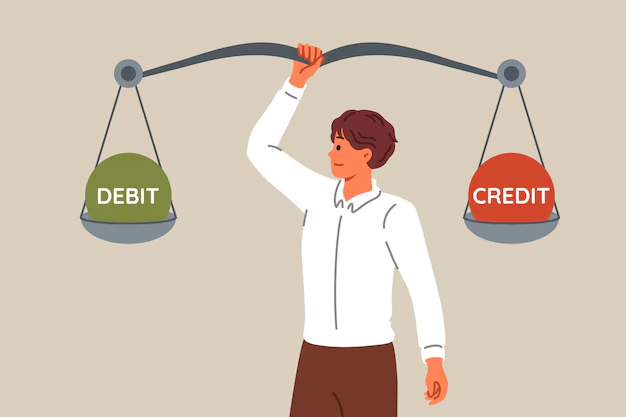
Options trading can be overwhelming, especially when it comes to strategies like spreads. Among the most popular are debit spreads and credit spreads. Both are powerful tools that traders use to control risk, lower costs, and maximize returns. However, they work differently — and knowing when to use debit spread vs credit spread can make a huge difference in your trading success.

In this blog, we’ll break down what debit spreads and credit spreads are, how they work, their pros and cons, and key scenarios where each strategy makes sense.

What is a Debit Spread?

A debit spread is an options strategy where you pay a net premium (cash outflow) to enter the trade.

It usually involves:

  • Buying one option (call or put) with a higher premium, and
  • Selling another option (same type, same expiration) with a lower premium.

Because you’re paying more for the option you buy than you receive for the option you sell, money leaves your account upfront — hence the term “debit” spread.

Example of a Debit Spread (Bull Call Spread)

Suppose Stock XYZ is trading at $100.

  • You buy a call option at $100 strike for $5.
  • You sell a call option at $110 strike for $2.

Your net cost (debit) = $5 – $2 = $3.
That $3 (or $300 per contract) is your maximum loss.

Your maximum gain = Difference between strikes – Net debit = ($10 – $3) = $7.

Hence, risk/reward is defined and favorable if the stock moves upward.

✅ Debit spreads are best when you expect directional moves.

What is a Credit Spread?

A credit spread is an options strategy where you receive a net premium (cash inflow) when entering the trade.

It involves:

  • Selling one option with a higher premium, and
  • Buying another option (same type, same expiration) with a lower premium.

Because you receive more money for the option you sell than you pay for the one you buy, money comes into your account upfront — hence the term “credit” spread.

Example of a Credit Spread (Bear Call Spread)

Stock XYZ is at $100.

  • You sell a call option at $105 strike for $4.
  • You buy a call option at $115 strike for $1.

Your net credit received = $4 – $1 = $3.
That $3 (or $300 per contract) is your maximum profit.

Your maximum loss = Difference between strikes – Net credit = ($10 – $3) = $7.

Hence, your profit is capped, but so is your loss.

✅ Credit spreads are best when you expect limited movement or range-bound trading.

Key Differences Between Debit and Credit Spreads

Feature Debit Spread Credit Spread
Cash Flow at Entry Pay net premium (cash outflow) Receive net premium (cash inflow)
Max Profit Difference between strikes – net debit Net premium received
Max Loss Net premium paid Difference between strikes – net credit
Best For Directional moves (bullish or bearish) Neutral/range-bound markets
Risk Management Lower risk vs outright long options Defined risk with capped returns
Probability of Profit (POP) Lower POP but higher reward-to-risk Higher POP but lower reward-to-risk

When to Use Debit Spreads

You might prefer a debit spread vs a credit spread when:

  • You expect a strong directional move in the stock.
  • You want to limit risk vs buying naked calls/puts.
  • You’re okay with a lower probability of profit but higher upside potential.

Example strategies:

  • Bull Call Spread (bullish)
  • Bear Put Spread (bearish)

When to Use Credit Spreads

You might prefer a credit spread when:

  • You expect the stock to stay within a range.
  • You want to generate consistent premium income.
  • You prefer a higher probability of profit, even with capped returns.

Example strategies:

  • Bull Put Spread (neutral to bullish)
  • Bear Call Spread (neutral to bearish)

Pros and Cons of Debit Spreads

Advantages

  • Limited risk and reward (defined outcomes).
  • Cheaper than buying naked options.
  • Great for directional trades.

Disadvantages

  • Lower probability of profit compared to credit spreads.
  • Time decay (theta) usually works against you.

Pros and Cons of Credit Spreads

Advantages

  • Receive premium upfront.
  • Higher probability of profit.
  • Time decay usually works in your favor.

Disadvantages

  • Limited profit potential.
  • Losses can be bigger than profits if the stock moves against you.

Real-World Example: Choosing Between Debit and Credit Spread

Let’s say you’re analyzing Apple (AAPL) before earnings:

  • If you believe Apple will rally strongly → Debit Spread (Bull Call).
  • If you think Apple will stay flat or not rise much → Credit Spread (Bear Call).

Both approaches have defined risk, but your choice depends on market outlook.

FAQs

Q1: Which is better for beginners — debit or credit spreads?
Debit spreads are usually easier for beginners since they are straightforward directional bets with defined risk.

Q2: Can debit and credit spreads be used together?
Yes. Advanced traders sometimes combine debit and credit spreads into strategies like iron condors or butterflies.

Q3: Do I need a margin account for spreads?
Yes, most brokers require a margin account, especially for credit spreads, since they involve selling options.

Q4: Are debit spreads safer than credit spreads?
Both are defined-risk strategies, but debit spreads limit losses to the upfront premium, while credit spreads can carry higher risk if the stock moves sharply.

Q5: Can spreads be adjusted after opening a trade?
Yes. Traders can roll spreads up/down or out to a later expiration to manage risk or lock in gains.

Final Thoughts

Both debit spreads and credit spreads are essential tools in an options trader’s toolkit. Debit spreads work best for directional bets with limited risk, while credit spreads shine in range-bound markets where traders collect premium income.

If you’re serious about mastering spreads and other advanced strategies, having the right guidance and alerts can save you time and money.

👉 At MySpyOptions, we specialize in helping traders navigate the options market with expert analysis and actionable trade insights. Whether you’re just starting or refining your strategies, we’re here to guide you.

Categories
Options Trading Uncategorized

Theta Decay in Options: How Time Works Against You?

Options trading is all about probabilities, timing, and strategy. Among the most important concepts, traders must understand, is theta decay—the gradual loss of value in an option as it approaches its expiration date.

If you’re new to options trading or looking to refine your strategies, mastering the impact of theta decay can make the difference between making consistent profits or unnecessary losses.

In this article, we’ll understand:

  • What theta decay is and why it matters
  • How it affects call and put options
  • Ways to take advantage of theta decay
  • Strategies to protect yourself from time decay losses

Let’s dive in.

What is Theta Decay in Options?

heta is one of the Greek words that means to measure risk and sensitivity to various factors. Specifically, in options trading, theta measures how much an option’s price decreases with each passing day, everything else being the same.

For example, if an option has a theta of -0.05, it means that the option loses $0.05 in value every day due to time decay.

This is why traders often say, “time is the enemy of the options buyers, but the friend of the options sellers.”

Why Does Theta Decay Happen?

Every option’s price consists of two components:

  1. Intrinsic Value – the actual value if exercised today.
  2. Extrinsic Value (Time Value) – the premium traders are willing to pay for the possibility of the option becoming profitable before expiration.

Theta decay occurs because as expiration approaches, the time value decreases and there is lesser time for the stock to move favorably.

  • Near expiration: time decay accelerates rapidly.
  • Far from expiration: decay is slower and less noticeable.

How Theta Decay Impacts Call and Put Options?

Theta decay doesn’t discriminate—it impacts both calls and puts. However, the effect varies depending on whether you are buying or selling options.

  • Option Buyers → Lose from theta decay. Every passing day chips away the premium they paid.
  • Option Sellers (Writers) → Benefit from theta decay. Every passing day increases the chance they keep the premium.

For example:

  • You buy a call option on a stock trading at $100, paying $5 in premium.
  • As time passes without the stock moving significantly, the option might lose $1–2 purely due to theta decay, even if the stock’s price stays flat.

This is why many traders prefer selling options or using spreads to offset time decay.

When is Theta Decay the Fastest?

Theta decay is non-linear. It accelerates as expiration nears.

  • 30–45 days before expiration → Time decay is moderate.
  • Last 2 weeks before expiration → Decay speeds up dramatically.
  • Final days → Options can lose value very quickly, especially in out-of-the-money contracts.

This is why many experienced traders either close positions early or design strategies specifically to profit from rapid decay.

Strategies to Take Advantage of Theta Decay

If you understand theta decay, you can turn time into your ally. Here are some strategies traders use:

1. Covered Calls

Owning 100 shares of stock and selling a call option against it. The premium you collect benefits from theta decay every day.

2. Cash-Secured Puts

Selling puts on stocks, you wouldn’t mind owning. As time passes, the premium erodes in your favor.

3. Iron Condors & Credit Spreads

Strategies designed to profit from both time decay and low volatility.

These strategies allow traders to “sell time” and profit as each day passes without large stock movements.

How to Protect Yourself From Theta Decay?

If you’re an options buyer, theta decay is your biggest enemy. Here’s how to reduce its impact:

  • Choose Longer Expirations → Options with more time value decay slower.
  • Exit Early → Don’t hold until the last days unless absolutely necessary.
  • Use Spreads → Debit spreads (buy one option, sell another) help offset time decay.
  • Be Strategic with Timing → Only buy options when you expect a big move soon.

Real-World Example of Theta Decay

Let’s say you buy a call option on Apple (AAPL) at $150 strike, expiring in 30 days. The option costs $4.50.

  • Day 1: Stock doesn’t move. Premium drops to $4.30 → Theta decay took $0.20.
  • Day 10: Still flat. Premium drops to $3.60.
  • Day 25: Now only 5 days left. Premium collapses to $1.10 unless AAPL moves strongly.

This is the power of theta decay working against buyers.

Key Takeaways

  • Theta decay is time decay. It leads to the daily erosion of an option’s value.
  • It accelerates as expiration nears, and hits buyers hardest near to expiry.
  • Sellers benefit from theta, while buyers must plan strategically to overcome it.
  • Using spreads, covered calls, or selling puts are ways to profit from theta decay.

FAQs

Q1: Can theta decay ever work in favor of buyers?
Yes. If the underlying stock moves strongly in the expected direction, the gains from delta (price movement) can outweigh the loss from theta decay.

Q2: Does implied volatility affect theta decay?
Yes. Higher implied volatility inflates option premiums, which can temporarily offset time decay. However, as volatility drops, time decay becomes more apparent.

Q3: Which options have the slowest theta decay?
Options with longer expirations (LEAPS) decay much slower compared to near-term contracts.

Q4: Do all options have negative theta?
Not always. Some complex spreads or option-selling strategies can result in positive theta, meaning time decay actually works in your favor.

Final Thoughts

Theta decay is one of the most important concepts in options trading. If you don’t understand how time works against your positions, you risk losing money even when you guess the stock’s direction correctly.

If you want expert guidance on options strategies, risk management, and trade alerts, consider reaching out to MySpyOptions. Our team specializes in helping traders navigate the complexities of the options market with confidence.