
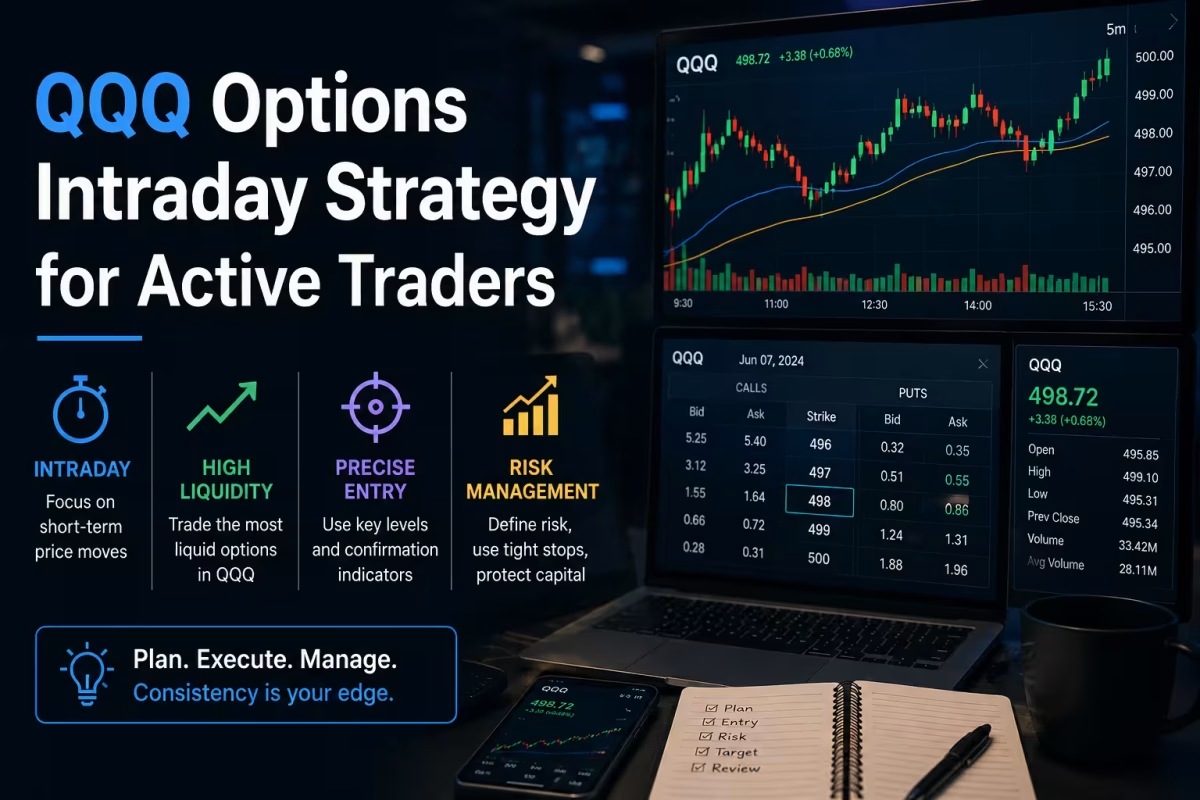
Trading Invesco QQQ Trust (QQQ) options within a single session can be exciting — but it’s also unforgiving. Because QQQ tracks the Nasdaq-100, it’s heavily driven by large-cap tech names and tends to swing hard within the day, which is exactly why it’s one of the most actively traded ETFs in the U.S. options market.
Volatility on its own doesn’t make money, though. A workable QQQ intraday strategy comes down to spotting high-probability setups, picking the right contract, managing risk, and sticking to entry and exit rules you decided on before the trade — not while you’re in it.
This guide walks through a structured approach to day trading QQQ options: how to prepare before the bell, how to confirm a setup instead of guessing at one, how to actually select a contract, and how to manage risk once you’re in the trade.
Why QQQ Works So Well for Intraday Options
QQQ suits intraday trading because of a fairly rare combination: deep liquidity, tight bid-ask spreads, strong daily movement, and an options market with expirations almost every day of the week. Put together, that means frequent setups and clean entries and exits — you’re rarely fighting the spread just to get in or out.
A few things drive that:
Liquidity. QQQ is consistently one of the most heavily traded ETFs in the market, which typically means faster fills, tighter spreads, and less slippage than you’d get on a thinner underlying.
Volatility that actually shows up intraday. With heavy weighting toward names like Apple, Microsoft, NVIDIA, Amazon, Meta, and Alphabet, QQQ reacts fast to CPI prints, Fed announcements, Treasury yield moves, and big tech earnings — the kind of catalysts that create real intraday ranges, not just drift.
Expiration flexibility. Daily, weekly, monthly, and LEAPS contracts all trade actively on QQQ, so you can match the contract to how long you actually expect the move to take.
Liquidity and volatility create the opportunity. What determines whether you keep the gains is execution discipline — which is really what the rest of this guide is about.
Intraday Trading vs. Swing Trading
Before building a QQQ intraday strategy, it’s worth being clear on what “intraday” actually means versus the swing approach covered in our guide to QQQ technical indicators.
| Feature | Intraday Trading | Swing Trading |
| Holding period | Minutes to hours | Days to weeks |
| Overnight risk | None | Yes |
| Time decay impact | Lower | Higher |
| Trade frequency | High | Moderate |
| Monitoring required | Continuous | Periodic |
| Decision speed | Fast | Moderate |
Intraday trading tends to appeal to traders who’d rather not carry overnight gap risk and who can actually watch the screen through the session — if you can’t sit at the charts, swing trading is usually the more realistic fit.
Preparing Before the Market Opens
Most of the edge in intraday trading QQQ options gets built before 9:30 AM, not during it. Traders who consistently do well tend to spend the first 30–60 minutes of their day preparing rather than trading — reviewing news, marking levels, and reading the broader tape.
Review overnight news. Fed commentary, CPI or PPI data, employment reports, major tech earnings, and geopolitical headlines can all set the tone for QQQ’s session.
Mark key price levels. Previous day’s high and low, overnight high and low, premarket support/resistance, gap levels, and round psychological numbers — these are the areas price tends to react at once the bell rings.
Read market sentiment. Are Nasdaq futures green or red? Are yields rising? Is the VIX ticking up? Are semiconductors leading or lagging the broader tape? This context tells you which direction has the wind at its back before you place a single trade.
The MySpyOptions Intraday Execution Framework™
Most retail traders start by picking an option contract, then try to justify it with a chart. That’s backwards. The MySpyOptions Intraday Execution Framework™ flips the order into five deliberate steps: understand the market, find a high-probability setup, confirm momentum, then — only then — select the contract and define risk.
Step 1 — Establish Market Context
Before touching an indicator, get a read on the environment: Is QQQ trending or chopping sideways? Is the move a reaction to scheduled data or just a random gap? Are large-cap tech names leading the tape or lagging it? Is volatility elevated? This context is what filters out the low-quality setups before you waste a trade on them.
Step 2 — Wait for Technical Confirmation
A directional view on the market is the starting point, not the trigger. The highest-quality intraday setups tend to show up when several signals agree at once — that’s usually the difference between real conviction and a move that fizzles in ten minutes.
Signals worth stacking:
- Price holding above the 9 EMA and 20 EMA for bullish setups
- VWAP acting as support on a pullback
- RSI above 55 and still climbing
- MACD bullish crossover
- Volume expanding into the move
- A clean break above intraday resistance, followed by a successful retest
Step 3 — Choose the Right QQQ Option Contract
A textbook chart setup can still lose money if the contract behind it is wrong. Strike, Delta, expiration, and liquidity all need to match the move you’re actually expecting — not just be “the cheapest option on the board.”
Picking an expiration:
| Expiration | Best used for | Advantage | Trade-off |
| 0DTE | Experienced traders | High leverage | Extremely fast Theta decay |
| 1–5 DTE | Most active traders | Balance of movement and time value | Slightly pricier premium |
| Weekly options | Longer intraday momentum plays | Less Theta pressure | Higher upfront cost |
If you’re still building consistency, 1–5 DTE contracts tend to offer more breathing room than same-day expirations, where a five-minute chop can wipe out most of the premium.
Picking a Delta:
| Delta | Typical use |
| 0.20–0.35 | Aggressive, low-cost, higher-leverage trades |
| 0.40–0.60 | Balanced intraday trading |
| 0.65–0.80 | Higher directional exposure |
| Above 0.80 | Trades almost like the underlying ETF |
For most retail traders, 0.40–0.60 Delta strikes a reasonable balance between responsiveness and cost.
Check implied volatility before entering. Is IV unusually elevated? Is a major economic release due today? Buying options right before a high-impact event can leave you exposed to volatility contraction — even when QQQ moves the direction you expected.
Step 4 — Execute Only High-Probability Setups
Not every wiggle in price deserves capital. The traders who do well tend to wait for a handful of repeatable setups rather than trading every candle.
Opening Range Breakout (ORB). Mark the opening range from the first 15–30 minutes, wait for a break above or below it on rising volume, then enter on the breakout or the first pullback with a stop just beyond the breakout level. Works best on days with strong participation from the open.
VWAP Pullback. In an uptrend, QQQ pulls back to VWAP, buyers defend the level, RSI holds above 50, and volume picks back up as price resumes higher. This lets you join a trend that’s already proven itself instead of chasing an extended move.
Momentum Continuation. Strong directional movement, higher highs and higher lows, rising volume, MACD confirming, and price holding above short-term moving averages. Rather than jumping in at the first breakout candle, patient traders often wait for a brief consolidation first.
The goal was never to trade often — it’s to trade when the odds are actually stacked in your favor.
The MySpyOptions Trade Scorecard™
Run through this before placing any intraday order:
- Overall market trend identified?
- QQQ trading clearly above or below VWAP?
- Does RSI confirm momentum?
- Does MACD align with the intended direction?
- Is volume supporting the move?
- Is the option’s Delta appropriate for the setup?
- Is liquidity sufficient (tight spread, adequate open interest)?
- Is risk-to-reward at least 2:1?
- Is the stop-loss defined?
- Is position size calculated in advance?
9–10 “yes” answers: high-quality setup. 7–8: proceed cautiously, if at all. Below 7: waiting is probably the better trade.
Intraday Decision Matrix
| Market condition | Strategy | Option type |
| Strong bullish trend | VWAP pullback | Buy calls |
| Strong bearish trend | Breakdown retest | Buy puts |
| Sideways market | Wait | No trade |
| High-volatility news event | Smaller size or wait | Defined-risk strategy |
| Low-volume session | Reduce activity | Avoid chasing |
Sometimes the best trade available is the one you decide not to take.
Risk Management for Intraday QQQ Options
Long-term results in day trading QQQ options come far more from controlling losses than from finding perfect entries. Before entering, define your maximum risk per trade (commonly 1–2% of account size), your stop-loss level, profit target, position size, and exit conditions — in that order, before you’re emotionally attached to the position.
Example: On a $25,000 account with 1% max risk, that’s a $250 cap per trade. If a contract costs $500 and your stop represents a 50% loss of premium, that math tells you exactly how many contracts you can hold without breaching your own limit — no guesswork required.
The goal isn’t squeezing the most out of every winner. It’s staying consistent enough to still be trading next quarter.
Common Mistakes Active Traders Make
Trading the first candle. The opening minutes are often the noisiest part of the session, full of false breakouts. Letting the market establish direction first usually improves setup quality.
Ignoring VWAP. Fighting VWAP without strong evidence usually means fighting institutional order flow — rarely a winning position.
Chasing extended moves. Buying after a big move has already happened tends to produce poor risk-to-reward, even if the direction is right.
Overtrading. More trades isn’t the same as better results. A handful of high-quality setups will usually outperform a full day of constant activity.
Sloppy position sizing. Even a strategy with genuine edge can underperform if size varies with emotion instead of a predefined rule.
Pre-Trade Checklist
- Market context reviewed
- Key support and resistance marked
- VWAP aligns with intended direction
- RSI and MACD confirm momentum — see our full breakdown of QQQ technical indicators if you need a refresher
- Volume supports the move
- Appropriate strike and Delta selected
- Implied volatility checked
- Stop-loss identified
- Position size calculated
- Economic calendar reviewed
A checklist you actually use beats a strategy you only remember half the time.
Learn QQQ Options Trading with MySpyOptions
A working QQQ intraday strategy isn’t just chart patterns — it’s market structure, options pricing, technical analysis, and risk management working together as one process. If you haven’t already, it’s worth pairing this guide with our breakdown of the best indicators for QQQ trading, which covers RSI, MACD, VWAP, and the rest of the toolkit referenced throughout this framework in more depth.
MySpyOptions builds practical, rule-based education for SPY and QQQ traders — reading options chains, understanding Delta, Theta, Gamma, and Vega, position sizing, and structured trading plans you can actually repeat. If contract mechanics are still new to you, our guide on calls versus puts is a good place to start, and if faster setups interest you beyond QQQ, see our take on options scalping strategies. More guides live on the MySpyOptions blog.
Key Takeaways
A workable QQQ intraday strategy is built on preparation, confirmation, and disciplined execution — not speed. The Intraday Execution Framework™ boils that down to five steps:
- Assess the market environment.
- Wait for technical confirmation.
- Choose the right option contract.
- Execute only high-probability setups.
- Manage risk and review every trade afterward.
Consistency comes from running the same process every session, regardless of how the day is going.
Frequently Asked Questions
What is the best QQQ intraday strategy?
Most active traders combine market context, VWAP, moving averages, RSI, and MACD, waiting for several of these to confirm before entering rather than trading off any single signal.
Which expiration is best for day trading QQQ options?
Many retail traders favor 1–5 DTE contracts for the balance between directional exposure and slower time decay compared to 0DTE. More experienced traders sometimes use same-day expirations once they understand the added Theta risk.
Is VWAP useful for QQQ options trading?
Yes — VWAP reflects the volume-weighted average price for the session and is widely used to confirm intraday trend strength and gauge institutional participation.
What Delta is suitable for intraday QQQ options?
A Delta between 0.40 and 0.60 is a common middle ground, balancing responsiveness to QQQ’s price with the cost of the contract.
How much should I risk on a single QQQ intraday trade?
Many experienced traders cap risk at 1–2% of account capital per trade, though the right number depends on account size, strategy, and personal risk tolerance.