
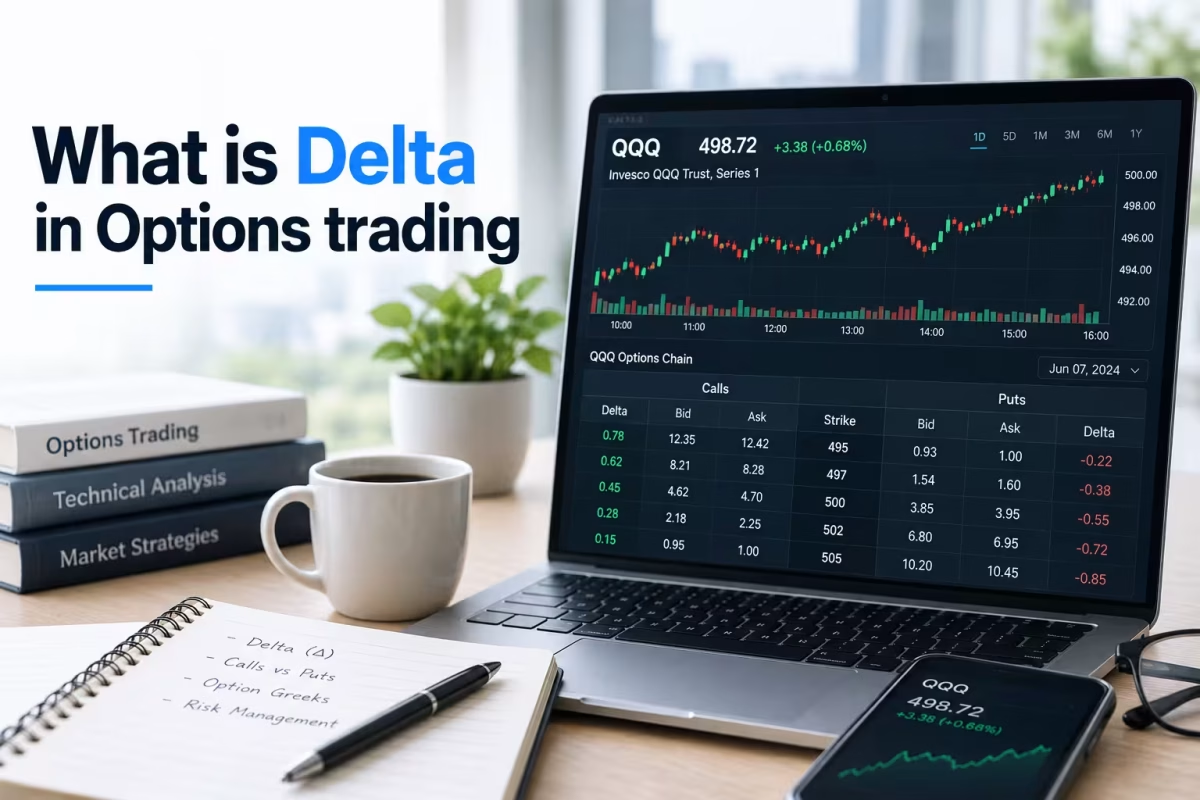
If you trade SPY or QQQ options, delta is usually the first Greek you’ll run into — and the one most traders misuse. In plain terms: delta options pricing tells you how much an option’s premium is expected to move for every $1 move in the underlying. A call with 0.55 delta should gain roughly $0.55 in premium if SPY rises $1; a put with -0.40 delta should gain roughly $0.40 if SPY falls $1.
That’s the short answer. The longer, more useful answer is what this guide covers — how delta behaves across strikes and expirations, why it’s not the fixed number people assume, and how to actually build it into a trade plan instead of treating it as a shortcut for “which strike do I pick.”
What Delta Actually Measures
Delta is one of the primary options Greeks, and it measures an option’s price sensitivity to the underlying asset. Calls carry positive delta (0 to +1.00). Puts carry negative delta (0 to -1.00). The closer the absolute value sits to 1, the more the option behaves like 100 shares of stock.
Say a SPY call has a delta of 0.55. If SPY rises $1, that option’s premium might climb by about $0.55 — or roughly $55 per standard contract, since one contract represents 100 shares.
That’s a first-order estimate, though. Delta itself shifts as SPY moves, which is where gamma enters the picture (more on that below).
Call Delta vs. Put Delta
| Position | Typical Delta | Directional Bias |
| Long call | 0 to +1.00 | Bullish |
| Short call | 0 to -1.00 | Bearish |
| Long put | 0 to -1.00 | Bearish |
| Short put | 0 to +1.00 | Bullish |
| Long stock | +1.00 | Bullish |
| Short stock | -1.00 | Bearish |
Notice the sign flips with the position, not just the option type. Buying a call gives you positive delta; selling that same call flips it negative. Positive delta positions generally profit as the underlying rises; negative delta positions generally profit as it falls.
How Delta Shifts Across ITM, ATM, and OTM Strikes
Delta tracks closely with moneyness.
For calls:
- Deep out-of-the-money (OTM) calls sit at low positive delta
- At-the-money (ATM) calls tend to hover near 0.50
- Deep in-the-money (ITM) calls push toward +1.00
For puts: the same pattern applies in reverse — deep OTM near zero, ATM near -0.50, deep ITM approaching -1.00.
These are tendencies, not fixed rules. Time to expiration and implied volatility both pull delta around.
A Practical Delta Ladder
| Approx. Delta | Typical Option Profile | What It Generally Signals |
| 0.10 | Far OTM call | Low immediate sensitivity, cheap premium |
| 0.25 | OTM call | Moderate directional exposure |
| 0.50 | Near-ATM call | Balanced sensitivity |
| 0.70 | ITM call | Stronger underlying exposure |
| 0.90 | Deep ITM call | Trades almost like the stock itself |
(Flip the signs for puts.) The trade-off is straightforward: lower delta means a cheaper option that needs a bigger move to pay off; higher delta means more sensitivity but a heftier premium. Picking the cheapest contract on the chain without checking delta is a common way to end up “right on direction” and still lose money.
Calculating Delta’s Impact on a Trade
The rough formula:
Estimated price change ≈ Delta × change in underlying price
Walk through a hypothetical SPY call:
- SPY: $650
- Strike: $650
- Premium: $5.00
- Delta: 0.50
- SPY moves up $2
0.50 × $2 = $1.00 estimated gain, taking the option from roughly $5.00 to $6.00 — about $100 per contract, before implied volatility, time decay, or spread widening get involved.
Here’s the catch: if SPY keeps moving, delta won’t necessarily stay at 0.50. That’s gamma’s job to measure — the rate at which delta itself changes — and it matters most for ATM options and anything close to expiration.
Treating a 0.50-delta option as though it’ll stay 0.50 through a large move is one of the fastest ways to misjudge P&L.
Delta vs. Gamma, Theta, and Vega
Delta is one piece of a bigger pricing picture.
| Greek | Measures | Question It Answers |
| Delta | Sensitivity to underlying price | How much could the option move on a $1 shift? |
| Gamma | Change in delta | How fast could that sensitivity shift? |
| Theta | Sensitivity to time | How much value erodes as expiration nears? |
| Vega | Sensitivity to implied volatility | What happens if IV changes? |
A trader can nail the direction on a short-dated SPY option and still lose money — either the underlying moves too slowly relative to theta, or implied volatility drops out from under the trade. This dynamic gets sharper the closer you get to expiration; CME Group notes the Greeks’ effects intensify as 0DTE contracts approach the close.
Delta answers the directional question. Gamma, theta, and vega explain why the real P&L often looks different from the simple delta math.
Using Delta to Choose SPY and QQQ Strikes
Here’s a five-step framework for putting delta to work rather than treating it as a lookup number.
- Establish the thesis first. Bullish, bearish, neutral, breakout, or mean-reversion — decide this using price action, VWAP, moving averages, RSI, MACD, or volume profile. Technical analysis sets the thesis; delta just translates it into a contract.
- Decide how much directional exposure you actually want. Expecting a sharp move? A higher-delta option responds more directly. Comfortable with less immediate sensitivity in exchange for a cheaper premium? Lower delta might fit better. There’s no universal “correct” number here.
- Check time to expiration. The same strike behaves differently depending on how much runway it has. Short-dated contracts can see delta and gamma swing fast; longer-dated ones give the thesis more room to play out, at a different premium and sensitivity profile.
- Check implied volatility. Delta doesn’t exist in a vacuum — IV shapes both the premium and the delta relationship across the chain, a point the Options Industry Council covers in more depth.
- Size the trade based on total risk, not delta alone. A 0.70-delta option isn’t automatically “safer” than a 0.30-delta one. Premium paid, expiration, position size, volatility, and your stop-loss method all factor into actual risk.
The Probability Misconception: What Delta Doesn’t Tell You
One of the most repeated (and most misleading) shortcuts in options trading: “a 0.30 delta means a 30% chance of finishing in the money.”
That’s a rough approximation at best, not a guaranteed forecast. Delta is a theoretical sensitivity measure, and its probability-like interpretation depends entirely on the pricing model’s assumptions. The Options Industry Council and similar resources treat delta as probability-adjacent, not probability-certain.
Saying “this 0.30-delta SPY call has a guaranteed 30% chance of profit” is simply wrong on two counts. First, delta isn’t a guarantee of anything. Second — and this trips up even experienced traders — finishing in the money isn’t the same as finishing profitable. An option can expire ITM and still lose money relative to what was paid for it.
A Better Framework: Exposure, Not Just Delta
Instead of asking “what delta should I trade,” run through four questions:
- Direction — What does price action and technical analysis actually suggest?
- Exposure — How strongly do you want the option to react? (This is delta’s job.)
- Acceleration — How fast could that exposure change? (This is gamma’s job, especially near expiration.)
- Cost of being wrong — What’s the actual dollar risk if the thesis fails?
This matters more for SPY and QQQ specifically because both underlyings can move quickly while short-dated contracts see their Greeks shift in real time.
| Trading Problem | Delta-Related Question to Ask |
| Option barely moves despite being right on direction | Is delta too low for the move size? |
| Option swings hard against you | Is delta/gamma exposure too aggressive? |
| Premium erodes despite limited movement | Is theta working against the position? |
| Value drops after a quiet session | Is vega/IV exposure the culprit? |
| Position feels oversized for the account | What’s the total dollar exposure, not just contract count? |
Six Mistakes Traders Make With Delta
- Treating delta as a guaranteed price change. It’s a theoretical, instantaneous estimate — not a promise.
- Assuming high delta means low risk. Higher delta means more directional exposure, full stop. It doesn’t remove risk.
- Ignoring gamma near expiration. Delta can move fast around ATM strikes as expiration closes in.
- Ignoring implied volatility. Correct direction doesn’t guarantee a good outcome if IV drops.
- Confusing ITM probability with profit probability. These are genuinely different things — see above.
- Picking strikes by delta alone. Delta is one input into a strike decision, not the whole decision.
How MySpyOptions Approaches Delta
Understanding delta on paper and applying it live are two different skills. MySpyOptions focuses specifically on SPY and QQQ options — not the entire options universe — which means the education stays practical: how delta, gamma, theta, and vega actually interact with VWAP, volume profile, price action, and expiration timing in real market conditions.
Rather than teaching the Greeks as isolated numbers to memorize, the goal is helping traders — from beginners through more experienced hands — understand why a given contract fits (or doesn’t fit) a specific trade plan. Explore the SPY and QQQ options courses or browse the full blog for more on strike selection, risk management, and the Greeks.
Delta Trading Checklist
Before entering a SPY or QQQ trade, run through this:
- What’s the directional thesis?
- What’s the option’s current delta?
- How could gamma move that delta?
- How much time is left until expiration?
- What’s the implied volatility environment doing?
- What happens if the underlying moves against the position?
- Is position size appropriate for the account’s risk limit?
- What’s the exit plan?
- Am I mixing up “probability of ITM” with “probability of profit”?
If any of these are hard to answer, the strike probably isn’t the real problem — the trade plan is.
FAQ: Delta in Options Trading
What does delta mean in options trading?
Delta measures the theoretical change in an option’s premium for a $1 move in the underlying, all else equal. Calls carry positive delta; puts carry negative delta.
What’s a good delta for buying options?
There isn’t a universal best answer. Higher delta means more directional sensitivity but a higher premium; the right choice depends on the setup, expiration, volatility, and risk tolerance.
Is a 0.50 delta the same as a 50% chance of profit?
No. It can be used as a rough, model-dependent proxy for probability of finishing ITM, but that’s not the same as probability of profit, and it’s never a guarantee.
What does a 0.30 delta mean?
Roughly, a $0.30 premium move for every $1 move in the underlying — and a loose, model-based hint at the odds of finishing in the money, not a fixed probability.
Why does delta change?
Because the underlying’s price, time to expiration, and implied volatility are all moving targets. Gamma is the Greek that measures how fast delta itself shifts.
Is higher delta always better for SPY or QQQ options?
Not necessarily. Higher delta means stronger directional exposure; lower delta options need a bigger move to pay off but cost less. It comes down to the thesis and the risk plan.
How does delta help with position sizing?
A 0.60-delta option behaves like roughly 60 shares of directional exposure per 100-share contract, before gamma and other Greeks shift that number. Adding up delta across positions (portfolio delta) helps gauge total directional risk.
The Bottom Line
Delta is best treated as an exposure tool, not a prediction engine. Use it to gauge sensitivity, pair it with gamma, theta, and vega, and let market context and risk management make the final call — not a single Greek in isolation.
Options carry real risk. As the SEC notes, buyers can lose their entire premium, and some option-writing strategies can expose traders to losses well beyond that. Trade size and strategy accordingly.