
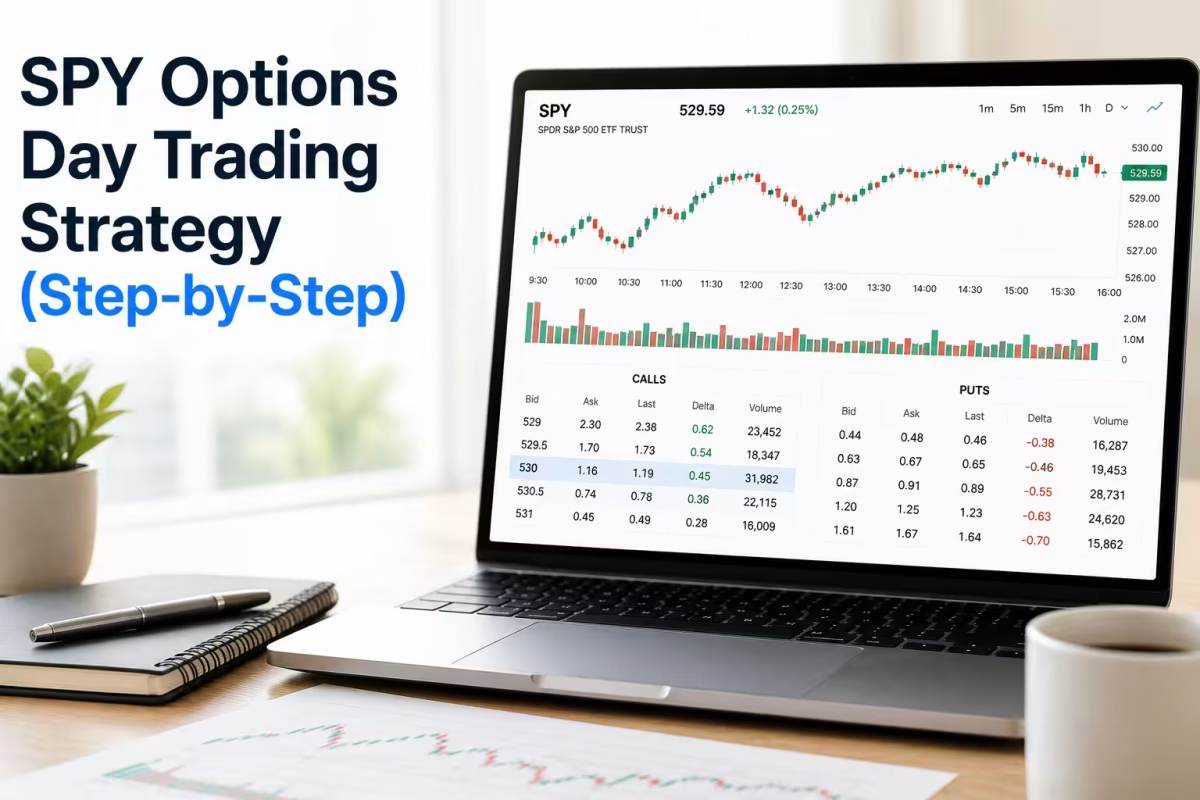
Day trading the stock market can feel overwhelming, especially when thousands of stocks are moving at the same time. Rather than scrolling through charts in search of opportunities, many traders prefer to focus on one liquid market: SPY options. SPY options track the S&P 500 Index, giving traders an access to 500 largest publicly traded US companies while providing high volumes in terms of options trading.
For active traders, SPY day trading options feature tight bid-ask spreads, numerous weekly expiries and intraday price moves. Whether you are a beginner or a professional trader seeking to perfect your trading style, this guide will help you make better decisions and prevent yourself from making any impulsive moves. This guide will further help you understand SPY options better, why they are favored by day traders, and how to construct a profitable intraday SPY options strategy.
What is a SPY ETF?
The SPDR S&P 500 ETF Trust (SPY) is an ETF that tracks the performance of the S&P 500 index. Established in 1993, SPY was the first ETF listed in the US and remains one of the world’s most actively traded financial products, serving billions of dollars in assets.
The S&P 500 represents the broader U.S. stock market, making SPY a reliable indicator of market direction. Since SPY tracks the performance of a stock market index rather than a single stock, its price movements are generally more stable and predictable, making it more attractive to the intraday traders.
Pros and Cons of Day Trading SPY Options
Before you implement an intraday SPY options strategy, you should understand a few pros and cons of SPY.
| Advantages (Pros) | Disadvantages (Cons) |
| Unmatched Liquidity: SPY trades millions of option contracts daily, resulting in a tight bid/ask spread. | Low Volatility: SPY tracks a diversified index and never produces 20%-plus single-day moves often seen in individual growth stocks. |
| Single Focus: There is no need to scan 200+ stocks every day. | Limited Setup Opportunities: Because of its steady movement SPY provides 1 or 2 high quality setup per day at maximum. |
| Multiple Expiration Dates: Having several weekly expirations, short-term contracts are affordable and easy to trade. | Over-Leverage Risk: The affordability of short-dated options can tempt traders to take oversized positions, increasing overall risk. |
SPY Options Basics and Greeks
Choosing the right option contract is as important as market prediction when it comes to SPY trading. As SPY options are American-style options, they can be executed before expiry date and have several different expiration dates every week.
Selecting Expiration
Although same-day expiration (0DTE) options offer high leverage, they lose their value very fast due to time decay.
The preferable option for professional day traders would be to select contracts that expire in 2 to 5 days (2DTE-5DTE).
One of the possible approaches is:
- Monday: Trade options with Wednesday or Friday expirations.
- Wednesday: Trade options with Friday or next Monday expirations.
- Friday: Trade options with next Monday or Wednesday expirations.
Using options with slightly longer expirations allows the trade more room to develop and reduces the influence of rapid time decay.
Understanding the Key Option Greeks
Prior to SPY day trading options, one must understand the Greeks that have the most significant influence on the pricing of options.
-
Delta
Delta measures how sensitive the option price is to a $1 change in SPY. Many day traders prefer options with Delta between 0.25 and 0.35, as they offer a good balance between affordability and responsiveness. The higher Delta options react quicker but also require a larger premium.
-
Theta
Theta is a measure that demonstrates how quickly SPY options decay in time. As time for expiration approaches, the rate of decay increases if SPY remains relatively unchanged. This is the reason why holding SPY options for too long can drastically decrease your gains.
-
Vega
Vega measures how the option price changes with volatility changes. If the implied volatility is exceptionally high, then option premiums are relatively expensive. Even in case SPY moves in your direction, the loss of volatility may decrease your profits. It is always better to check the implied volatility prior to entering a trade.
Step-by-Step SPY Day Trading Options Intraday Execution Process
Now that you understand the basics, below is the step-by-step process, commonly used by many traders for trading reversals around major volume profile levels.
Step 1: Identify the Important Technical Levels
Compare the previous day’s high, low, major support levels and major resistance levels. Then compare these levels with Volume Profile areas, paying particular attention to low-volume nodes (LVNs) and other important price zones. For example If SPY has an important resistance level at around $403.00, then that price becomes a key area to monitor and should be targeted.
Step 2: Monitor the Price Action Around Important Levels
Allow SPY to reach your identified technical levels and look for signs that momentum is beginning to weaken. These signs may include:
- Price stalling near resistance
- Smaller candlestick bodies
- Multiple failed attempts to break through a level
- Sideways consolidation after a strong move
Step 3: Verify the Signal
Wait for the price to start moving in the direction you expect to see with a larger volume. This ensures that there will be a reduced chance of getting into a fake breakout/reversal trade.
Step 4: Pick the Right Option Contract
After your set up has been confirmed, choose the options contract preferably a Put option that expires in 2 to 3 days and with Delta between -0.30 and -0.40, normal implied volatility (generally below 25%) and tight bid-ask spread, ideally between $0.01 and $0.03.
Step 5: Execute the Trade and Control Your Risk
Execute the trade as per your plan, either at the confirmation candle or after a small pullback. Set the stop-loss level based on the underlying SPY price. For example if SPY breaks convincingly above the resistance level that justified your trade, exit the position regardless of the option’s price. As the SPY moves in your favour, take partial profits at the key support levels while managing the remaining position.
Key Intraday Trading Windows
Historical volume patterns suggest that returns are not equally distributed throughout the trading day and some trading sessions provide better opportunities than others. Below is the list of three main trading windows for an intraday SPY options strategy.
| Trading Window | Time (ET) | Characteristics & Focus |
| The Opening Drive | 09:30 AM – 10:30 AM | High volatility – Best for momentum & breakout setups |
| The Midday Lull | 11:30 AM – 02:30 PM | Choppy & low volume – Avoid opening new positions |
| The Power Hour | 03:00 PM – 04:00 PM | High institutional volume – Trend continuation & rebalancing |
Common Mistakes to Avoid
Many beginners lose their money by making certain avoidable mistakes. Knowing these mistakes in advance will definitely help you to improve your trading.
These include:
- Trading without a proper plan or defined risk.
- Choosing the options contracts with low liquidity and large spread.
- Not checking the implied volatility before entering a trade.
- Holding the contract too close to expiration.
- Overtrading in a slow or sideways market.
- Entering the trade without confirmation.
- Risking too much of your money on a single position.
- Letting emotions influence your trading decisions.
- Missing the stop-loss and target levels.
Avoiding these mistakes in advance will definitely improve your results.
Conclusion
A successful SPY day trading options approach is based on preparation, discipline and consistent execution, rather than trying to capture every market move. If you’re looking to sharpen your SPY trading skills with actionable insights, proven market analysis, and practical trading education, visit MySPYOptions, your trusted trading partner, to receive training, trading tips, and expert market insights.
FAQs
What is the best SPY option expiration for day trading?
The most preferable options for intraday traders are those that expire 2 to 5 days (2DTE–5DTE) from the trading date.
What indicators are the best for SPY day trading options?
The most frequently used indicators include support and resistance levels, moving averages, volume profile, volume analysis and multiple timeframe confirmation.
Can beginners trade SPY options?
Yes, but they must understand how option pricing, implied volatility and risk management works before starting trading with real money.
How much capital is needed for SPY options trading?
It depends on the trading strategy and risk appetite. Many traders start trading with smaller accounts and focus on strict position sizing, rather than using maximum leverage.
What is the difference between SPY options and SPY shares?
SPY shares represent ownership in the ETF itself, while SPY options give you the right to buy or sell SPY at a set price before expiration. Options offer greater leverage but also carry higher risk due to time decay and volatility.