
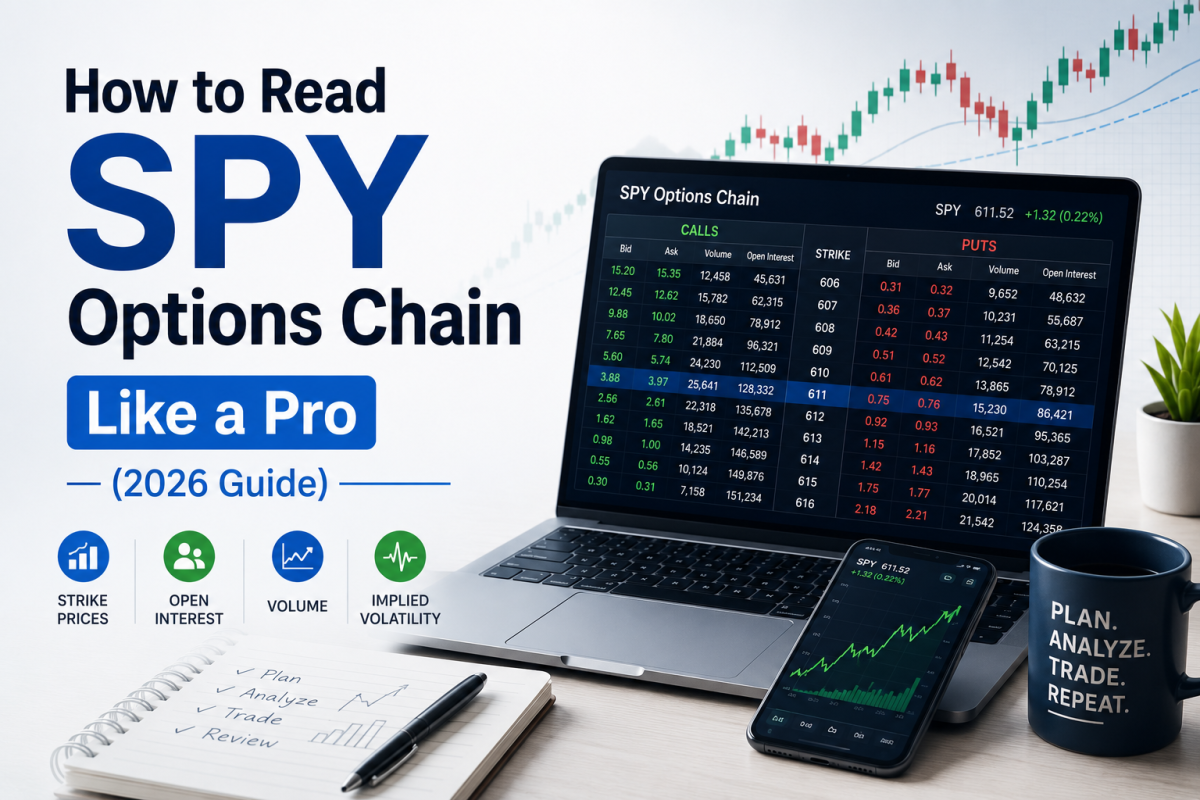
The SPY options chain is probably one of the most effective tools traders can use to gauge market sentiment, identify potentially profitable setups, and optimise the timing of entries and exits. By learning how to read the SPY options chain effectively, you can identify areas of liquidity, support and resistance, and determine the best times to trade SPY options.
In this guide, you’ll learn how to read the SPY options chain like a professional, discover the best time to trade SPY options, understand SPY intraday trading hours, and improve your intraday trading skills.
What Is a SPY Options Chain?
The SPY options chain contains all available call and put option contracts related to the exchange-traded fund SPDR S&P 500 ETF Trust (SPY). It provides traders with valuable market information, including:
- Strike prices
- Bid/ask prices
- Volume
- Open interest
- Implied volatility
- Delta, Gamma, Theta, Vega
In essence, an options chain serves as a live snapshot of trader positioning. While price charts reflect past market activity, an options chain provides insight into potential future price movements.
Why Reading the SPY Options Chain Matters?
Most traders primarily rely on candlestick charts. However, professional traders combine chart analysis with options chain data because it provides deeper insight into market positioning and trader sentiment.
1. Market Positioning
The open interest indicator helps identify where institutional and large market participants have positioned their capital.
For instance, if SPY has exceptionally high call open interest around the 620 strike price, that level is likely to act as a significant resistance zone.
2. Identify Liquid Trading Areas
Higher trading volume generally results in greater liquidity, making it especially important for scalpers and intraday traders.
3. Identify Possible Pinning Levels
As expiration approaches, SPY often gravitates towards strike prices with significant open interest.
4. Analyze Implied Volatility
Implied volatility helps determine whether option premiums are relatively expensive or inexpensive.
Problems → Solutions:
Unknown entry points → Analyze Implied volatility and trading volume.
How to Read SPY Options Chain Step by Step?
1. First Step: Choose The Right Expiration
The first step is choosing the appropriate expiration date.
For SPY, the choices include:
- Same Day Expiry (0DTE)
- Weekly Expiration
- Next Day Expiration
Since these options expire within a very short period, their prices respond quickly to intraday price movements.
Best suited for:
- Scalpers
- Momentum Traders
- News Trading
If you are an intraday trader, choose same-day expiry contracts, since their premiums move quickly due to high gamma.
2. Select At-The-Money Options
At-the-money (ATM) options are those with strike prices closest to SPY’s current market price.
For instance:
SPY Price: 612
Recommended contracts:
- 612 Call
- 612 Put
These contracts generally:
- Have the highest trading volume
- Offer excellent liquidity
- Feature fairly priced premiums
These options are best suited for beginners.
Tool → Function:
ATM Strike = Better liquidity + Efficient execution
3. Analyse Open Interest
Open interest indicates the number of active option contracts.
Higher open interest generally indicates stronger market participation and better liquidity.
General Framework:
- High Calls OI = Resistance Zone
- High Puts OI = Support Zone
For example:
| Strike Price | Call OI | Put OI |
| 610 | 18,000 | 9,500 |
| 615 | 32,000 | 8,200 |
| 620 | 41,500 | 6,100 |
Interpretation: 620 could become an important resistance level.
Hence, open interest helps traders identify potential market barriers.
4. Monitor Volume for Intraday Signals
Trading volume reflects the current level of market activity and is often more important than open interest for intraday traders.
Points to keep in mind:
- Rising call volume indicates bullish momentum.
- Rising put volume indicates bearish momentum.
- Unusually high volume frequently suggests institutional participation.
Ultimately, trading volume reflects current market interest and can help confirm trade setups.
Strategy → Result:
Use trading volume → Higher-confidence entries
5. Watch the Bid-Ask Spread
A tighter bid-ask spread is generally preferable.
For instance:
- Good Bid/Ask: 2.50 – 2.53
- Poor Bid/Ask: 2.50 – 2.90
A wider spread often results in increased slippage, reducing profitability.
Whenever possible, trade highly liquid contracts with tight bid-ask spreads—especially during the most active SPY trading hours.
6. Use Delta for Trend Identification
Delta measures how much an option’s price is expected to change for every $1 move in SPY.
For example:
- Delta: 0.50
- SPY rises by $1.
- The option premium increases by approximately $0.50
General Guidelines:
- A delta of 0.30 – 0.40 is cheap and less sensitive.
- 0.50 – 0.70 is neutral.
- 0.80+ is expensive and highly sensitive.
For most intraday traders, a delta between 0.40 and 0.60 offers an effective balance between responsiveness and affordability.
What Is the Best Time to Trade SPY Options?
Perhaps one of the most critical questions traders ask is when to trade SPY?
The most favourable SPY intraday trading periods are typically during the market open and the final hour of the trading session.
Market Open (9:30 AM – 11:00 AM EST)
This time slot offers:
- High volatility
- High trading volume
- Strong price movements
Good for momentum traders.
Power Hour (3:00 PM – 4:00 PM EST)
The final trading hour is another favourable period for trading SPY options.
During this time:
- Institutional traders often rebalance their portfolios.
- Trading volume increases significantly.
- Volatility typically rises.
Strong directional moves frequently develop before the market closes.
Comparison table:
| Time Window | Volatility | Best For |
| 9:30–11:00 AM | Very High | Scalping, Breakouts |
| 11:00–1:30 PM | Low | Avoid / Low conviction |
| 1:30–3:00 PM | Medium | Trend continuation |
| 3:00–4:00 PM | High | Power hour setups |
Key takeaway:
If you’re wondering when to trade SPY options, focus primarily on the market open and the Power Hour, when liquidity and volatility are typically at their highest.
Common Mistakes Traders Make While Reading the SPY Chain
Ignoring Open Interest
OI helps identify support and resistance areas.
Trading Illiquid Strikes
Slippage occurs due to low volume.
Buying during Periods of Low Volatility
Intraday premiums may be affected by low midday volatility.
Ignoring Implied Volatility
Ignoring IV may result in paying excessively high premiums or purchasing options that have limited profit potential.
Ignoring Time-Based Approach
Understanding SPY intraday trading hours is just as important as identifying the right strike price.
Pro-Level SPY Options Chain Framework
Follow this 5-step framework:
Step 1: Identify market bias
Begin by analyzing the SPY price chart and overall market direction.
Step 2: Identify the highest OI
Locate strike prices with the largest concentration of open interest.
These levels frequently act as important support and resistance zones.
Step 3: Watch real-time volume
Observe whether buying or selling activity is increasing.
Step 4: Trade only when volume is highest
Enter trades only when trading volume supports the setup.
Step 5: Choose ATM or near-ATM options
At-the-money or near-the-money contracts typically provide:
- Better liquidity
- Fairer premiums
- Faster price movement
- Easier trade execution
For example: An options trader observes SPY at the 615 level with heavy call OI at 620 and increasing volume at 617.
Conclusion: Bullish market with resistance ahead.
Trading strategy: Buy 617 call options during the day’s breakout.
Outcome: If momentum continues, the option premium appreciates as SPY advances toward resistance.
Following a structured framework like this helps traders make disciplined, data-driven decisions instead of relying on emotion.
Why Traders Trust Myspyoptions
Understanding SPY and QQQ options becomes much simpler with experience.
With over 15 years of market experience, Myspyoptions has helped more than 1,000 traders develop practical options trading skills by simplifying complex market concepts into actionable trading strategies.
What Myspyoptions offers:
- Alerts for SPY, QQQ options & stock options
- SPY & QQQ alert only services
- Professional options trading coaching
- Daily Market Insights
- Regular market updates
- Battle-tested options trading strategies
Instead of guessing your SPY entry points, you can make more informed trading decisions using proven strategies developed through years of market experience.
Ready to learn how to trade SPY options quickly?
Sign up with Myspyoptions now and benefit from real-time SPY and QQQ alerts, professional guidance, and proven trading strategies based on 15 years of market experience.
Conclusion
Reading the SPY options chain is just not about analysing numbers—it is also about understanding market psychology.
By combining:
- Open Interest
- Volume
- Delta
- Market Time
- Liquidity
traders gain valuable insights that many retail investors overlook.
Learning to interpret the options chain systematically can help you identify stronger trading opportunities, improve your timing, and make more informed decisions.
If you require further assistance on options trading in the US, please contact Myspyoptions.
FAQs
1. What should beginners focus on while reading an SPY options chain?
Beginners should concentrate on four key factors:
- At-the-money (ATM) strike prices
- Trading volume
- Open interest
- Expiration dates
These metrics provide a solid foundation for understanding market activity and selecting appropriate trades.
2. What is the best time to trade SPY options?
It is ideal to trade between 9:30–11:00 AM and 3:00–4:00 PM. These sessions typically offer the highest trading volume and volatility.
3. Why is open interest important?
Open interest helps identify potential support and resistance levels
4. Which is better, SPY or QQQ, in options trading?
SPY generally offers greater liquidity and tighter bid-ask spreads, making it suitable for a wide range of traders.
QQQ, on the other hand, tends to experience larger price swings due to the higher volatility of technology stocks, offering greater profit potential—but also higher risk.
5. When should I not trade SPY intraday?
Avoid trading during midday hours when trading volume and volatility typically decline unless there is significant market news or a strong trend continuation.