
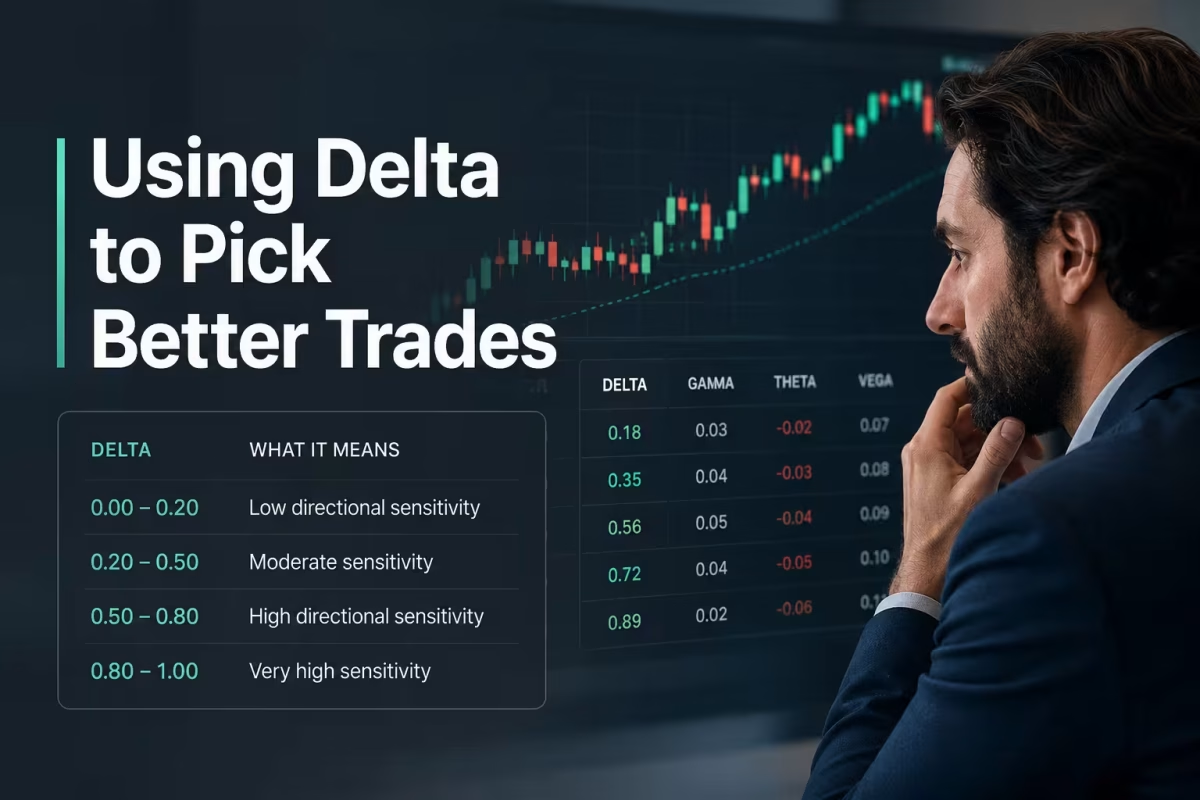
Most traders learn the textbook definition fast: delta measures how much an option’s price is expected to move for every $1 change in the underlying. That part’s easy. What that definition leaves out is how to actually build a delta trading strategy around it — one that matches a contract to your market outlook, your risk tolerance, and the move you’re actually expecting.
Whether you’re trading SPY or QQQ, this is where most beginners go wrong. They don’t misjudge direction — they pick the wrong contract for the direction they got right.
What Delta Is and Why It Matters to a Trading Strategy
Delta measures how much an option’s premium is expected to change for a $1 move in the underlying. It’s also a rough gauge of directional exposure, useful for comparing one contract against another.
A few quick reference points:
- A 0.20-delta call might gain roughly $0.20 on a $1 move in SPY
- A 0.50-delta call might gain roughly $0.50
- A 0.80-delta call might gain roughly $0.80
The higher the delta, the more the option trades like the underlying stock itself.
Here’s the trap most new traders fall into: they ask “which contract is cheapest?” instead of “which contract gives me the right balance of cost and exposure?” That second question is what a real delta trading strategy is built around — and it’s the difference between an option that responds when you’re right and one that barely moves.
The MOVE Framework for Delta-Based Trade Selection
At MySpyOptions, we teach delta selection through a framework we call MOVE — Market outlook, Option exposure, Volatility environment, Exit plan. It’s a simple way to keep delta from becoming a guessing game.
M — Market Outlook
Start with your directional bias: strongly bullish, moderately bullish, neutral, moderately bearish, or strongly bearish. This should come from technical analysis — VWAP, moving averages, RSI, MACD, volume profile, price action — never from delta itself. Delta translates a thesis; it doesn’t generate one.
O — Option Exposure
This is where delta actually does its job.
| Delta Range | Exposure Level | Typical Use |
| 0.10–0.25 | Low | Speculative trades |
| 0.25–0.40 | Moderate | Controlled risk |
| 0.40–0.60 | Balanced | Common retail choice |
| 0.60–0.80 | High | Strong-conviction trades |
| 0.80+ | Very high | Deep ITM positions |
V — Volatility Environment
Always check implied volatility before entering. High IV inflates premiums, and an expensive option can underperform even when your directional call is correct — the move has to clear a higher bar just to break even.
E — Exit Plan
Decide before you’re in the trade, not after: profit target, stop-loss level, position size, and risk-to-reward ratio. A delta trading strategy without an exit plan is just a guess with extra steps.
Matching Delta to Your Trading Style
The “right” delta shifts depending on what kind of trade you’re running.
Day trading SPY and QQQ usually calls for moderate-to-higher delta, roughly 0.40–0.70, since these contracts respond faster to intraday moves without paying up for deep ITM pricing.
Swing trading tends to sit a bit lower, around 0.30–0.60, balancing participation in the move against premium cost over a longer hold.
High-conviction trades — the ones where technical analysis lines up cleanly — can justify 0.60–0.80 delta, since these contracts track SPY or QQQ more tightly.
Speculative trades in the 0.10–0.30 range can produce outsized percentage gains on a big move, but they also expire worthless far more often. Know which trade you’re actually making before you pick the delta.
Delta and Risk Management: The Part Traders Skip
Say SPY is trading at $700 and you’re comparing three contracts:
| Contract | Delta | Premium |
| Option A | 0.25 | $2.00 |
| Option B | 0.50 | $5.00 |
| Option C | 0.80 | $12.00 |
A beginner often grabs Option A because it’s cheap. An experienced trader looks past price to expected move, probability of success, time to expiration, position sizing, and risk-to-reward — and sometimes the more expensive contract turns out to be the better risk-adjusted choice.
Delta is exposure. More delta means bigger gains when you’re right and bigger losses when you’re wrong, which is exactly why position sizing has to move in lockstep with delta selection — not as an afterthought.
How Delta Works Alongside the Other Greeks
Delta only tells part of the story.
| Greek | Primary Role |
| Delta | Directional exposure |
| Gamma | How fast delta itself accelerates |
| Theta | Time decay |
| Vega | Sensitivity to implied volatility |
Higher gamma means faster gains and faster losses — more sensitivity to every tick. A trader can call the direction correctly and still lose money to theta grinding away at the premium. And a drop in implied volatility can hurt a long option even while price moves the “right” way. Understanding all four together — a point CBOE’s options education resources also emphasize — is what separates a coherent strategy from a lucky guess.
Delta Mistakes That Undercut a Trading Strategy
Treating delta like a buy signal. It isn’t one. Delta measures sensitivity, not direction — it has no opinion on where price is headed.
Defaulting to the cheapest contract. Cheap usually means low delta, which usually means the underlying needs a much bigger move just to break even.
Ignoring theta. No amount of favorable delta rescues a position from severe time decay if the move doesn’t happen fast enough.
Ignoring implied volatility. Elevated IV inflates prices and can quietly work against an otherwise correct trade.
Chasing returns without a risk plan. Every position should start with “what am I risking,” not “what could I make.”
Learn Delta Trading Strategy with MySpyOptions
Knowing what delta means and using it consistently under live market conditions are two different skills — and the gap between them is where most traders lose money. MySpyOptions teaches delta as part of a broader SPY and QQQ framework that ties together technical analysis, trade planning, risk management, options-chain reading, position sizing, and execution.
The focus stays specific to SPY and QQQ rather than trying to cover every underlying on the market, which means real examples instead of generic theory. Explore the SPY and QQQ trading courses or browse more strategy breakdowns on the blog.
Delta Trading Strategy Checklist
Before entering a trade:
- What’s the market thesis, and where did it come from?
- What’s the option’s delta?
- Does that delta match your actual conviction level?
- What’s implied volatility doing right now?
- How much is genuinely at risk?
- Where’s the stop-loss?
- Where’s the target?
- How much will theta work against (or for) this position?
- Is position size appropriate for the account?
- What would prove the thesis wrong?
Market outlook, delta exposure, and risk management working together — that’s what separates a repeatable strategy from a one-off lucky trade.
The Bottom Line
There’s no magic delta number. A working delta trading strategy comes from matching option exposure to your actual market expectation and risk tolerance, then backing it up with technical analysis, implied volatility awareness, position sizing, and real exit discipline.
Next time you pull up an options chain, skip the instinct to grab the cheapest contract. Look for the one whose delta actually matches the trade you’re trying to make.
Frequently Asked Questions
What is a delta trading strategy?
It’s an approach to selecting option contracts based on delta, matched to your expected market move, risk tolerance, and trading objective — rather than picking a strike by price alone.
What delta is best for buying call options?
No single number is universally best. Many retail traders gravitate toward 0.40–0.70 delta for a balance of responsiveness and premium cost, but the right range depends on the trade style and conviction level.
Is higher delta always better?
No. Higher delta means more directional exposure, which cuts both ways — bigger gains when correct, bigger losses when wrong.
How does delta help choose option strikes?
It gives traders a way to compare contracts on cost, exposure, and rough probability of finishing in the money, rather than picking by premium price alone.
Can delta predict profits?
No. Delta estimates price sensitivity. Actual profit depends on direction, implied volatility, time decay, trade management, and position sizing all working together.
Why does delta change over time?
Because the inputs behind option pricing change — the underlying’s price, implied volatility, and time remaining until expiration all shift delta as they move.