
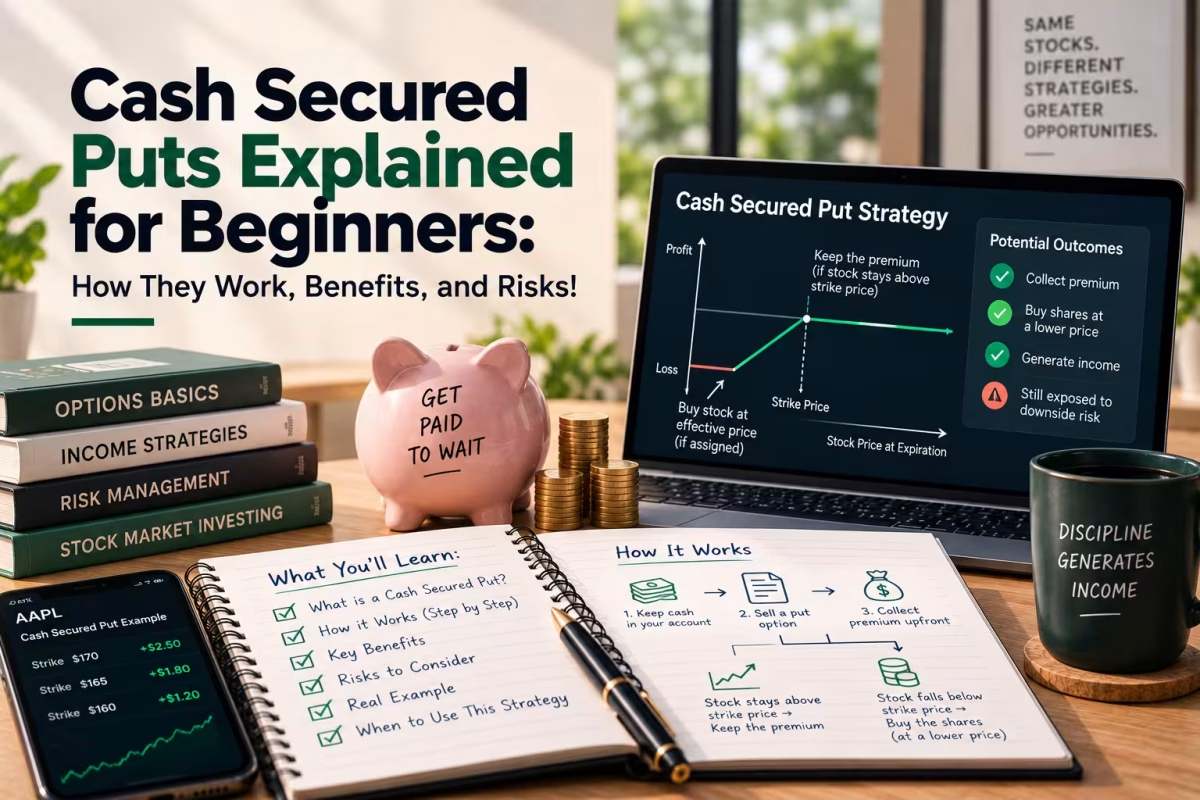
A cash-secured put is an options strategy that may assist investors in earning income from option premiums while seeking to buy the underlying stock at a preferred price. In this strategy, rather than buying the stock immediately, an investor writes put options and keeps some cash available for buying the shares in case of exercise of those options. This strategy may be beneficial for the investor when they are neutral to slightly bullish on a stock and are ready to own the stock at the chosen strike price.
However, the premium received from writing puts doesn’t cover the downside risk if there is a drastic fall in the underlying stock. In this article, we’ll learn about the basics of cash secured puts and their profits and losses, their application, and risks for beginners. Read on for a detailed analysis!
What are Cash Secured Puts?
A cash-secured put is the sale of a put option accompanied by the maintenance of the required amount of cash in the broker’s account for the purchase of the underlying shares in case the option is assigned. The premium is earned in return for the acceptance of the obligation to buy the stock at the previously agreed strike price.
The typical size of the standard equity options contract is equal to 100 shares, even though the details of the contract may differ across the markets and underlyings. So, in case the investor sells a put with a $50 strike price, then the necessary cash for 100 shares will be $5,000. The received premium will lower the cost of the purchase of the stock.
The term “cash-secured” stands for the money set aside for the potential purchase of the stock. Unlike a naked put, a cash-secured put is backed by sufficient cash rather than relying on margin to meet the potential purchase obligation.
How Do Cash Secured Puts Work?
The process starts with choosing a stock that the investor would want to buy. The investor does not buy this stock at the prevailing market price but sells a put option at a chosen strike price that represents their desired entry price.
There are two outcomes in this situation:
- The stock is above the strike price: The put may expire without value, therefore allowing the investor to receive the whole premium without owning any stock.
- The stock is below the strike price: The put will be assigned, and the investor will be obligated to purchase the stock at the strike price as per the conditions of the contract.
The premium provides partial protection against the fall of the price. The cost basis after the assignment is usually estimated as follows:
Effective Cost Basis = Strike Price – Premium Received
So, in the case of the sale of a $50 put with the $2 premium, the cost basis is equal to $48 per share.
Cash-Secured Put Example
Assume that the stock is trading at $85, and an investor wishes to buy the stock at $80. The investor sells one put contract with an $80 strike and gets a premium of $2 per share, or $200 in total for 100 shares.
The investor will keep $8,000 as cash for buying the shares if they fall below $80.
In case the stock is at $82 at expiration, then the put would remain out of the money and would expire without any value. The investor keeps the premium of $200 and doesn’t buy any shares.
If the stock falls to $70, the put will be assigned and the investor can buy 100 shares at the $80 strike price. After accounting for the $200 premium, the effective cost basis will be $78 per share. This shows that the cost basis remains $78 even when the stock falls significantly below the strike price.
This worked cash secured put example shows that the premium lowers the effective purchase cost but does not protect the investor from losses if the stock continues to decline.
Maximum Profit and Break-Even Price
The maximum profit for cash secured puts is equal to the premium received.
Maximum Profit = Premium Received × Number of Shares
For one contract with a premium of $2, the maximum profit is $200.
The break-even price is:
Break-Even Price = Strike Price − Premium Received
With an $80 strike price and $2 premium, the break-even price is $78. Above $78, the position can be profitable at expiration, while below $78, the position results in a loss if the put is assigned. If the stock remains above the $80 strike price, the put may expire worthless and the investor keeps the full $200 premium.
But here the risk is that if the stock price goes to zero, the maximum loss, which is calculated as Maximum Loss = (Strike Price − Premium) × Number of Shares, will be ($80 − $2) × 100 = $7,800, not including the transaction cost.
The following summary shows the key figures from the $80 strike and $2 premium example:
| Strike Price | Premium | Cash Required | Break-Even | Max Profit | Max Loss |
| $80 | $2/share ($200 total) | $8,000 | $78 | $200 | $7,800 |
A cash secured put calculator can use these same inputs to estimate the cash requirement, break-even price, maximum profit, and maximum potential loss for a trade.
Why Do Investors Use Cash-Secured Puts?
One of the reasons investors use cash secured puts is because of the possibility of premium income with the desired entry price for the stock. Rather than just placing a limit order and waiting for execution, the investor gets premium income in return for taking on the obligation of buying the shares at the selected strike price.
The strategy can serve several objectives:
- To get premium income: The seller receives the premium for opening the position.
- To target a lower price for entry: The investor selects a strike price below the stock’s current market price.
- To reduce the effective entry cost: If the put is assigned, the premium received lowers the net cost of acquiring the shares.
- To put cash to good use: The capital kept aside for future stock purchase generates option premium while the position remains open.
- To maintain a neutral to moderately bullish outlook: The seller expects the stock to remain at or above the strike price through expiration.
How to Trade Cash-Secured Puts
Trading cash secured puts involves selecting the stock, strike price, expiry, and premium and keeping sufficient cash for the assignment of shares. The following are the key steps to trade cash-secured puts:
1. Choose the Underlying Stock
Choose the stock that you have studied and are comfortable trading with even if the market goes against you. Quality, valuation, liquidity, and implied volatility may affect the choice of the stock.
2. Choose the Strike Price
The strike price should reflect how much you are willing to buy the stock at. Out-of-the-money puts are used mostly in such cases.
3. Sell Put to Open
Sell the put option while having enough cash to cover your assignment obligation. The premium is credited to the account by the broker.
4. Managing or Exiting Position
If the stock stays above the strike price, the option can expire without any action. You can also buy the put option to close your position before the expiration date. If the option is assigned, the investor purchases the shares at the strike price and then manages the resulting stock position
Some traders choose to close or adjust their positions before the expiration date after capturing most of the available premium, however, the actual approach may vary based on your trade and risk management strategy.
Risks Associated with Cash-Secured Puts
Though the reserve of cash adds some structure to the trade, cash secured puts are not risk-free trades. Here are some possible risks of this strategy:
- Stock decline: The investor can receive stocks after the assignment, which will be worth much less than the strike price.
- Limited profit: The maximum profit is limited to the premium, and the stock increase does not add any extra profit.
- Capital lockup: Money needed for the potential assignment can’t be freely used to enter new positions until you close or change the existing one.
- Opportunity loss: In case of a significant stock increase without reaching the strike, the investor earns the premium but misses the opportunity to get the shares at a lower price.
- Fundamental deterioration: A stock that looked attractive when the put was sold may later face weaker earnings, business problems, or changing market conditions.
Conclusion
Cash secured puts can offer a way to collect premiums and target the desired price for buying stocks. However, this strategy works well only for those who have enough cash and are ready to own the underlying stock in case of its price fall. The collected premium can reduce the effective cost, but the strategy can still result in significant losses because of falling prices.
To turn options concepts into practical market understanding, explore MySPYOptions for actionable education, market perspectives, and trading insights that can support more informed options decisions.
FAQs
1. What are cash secured puts?
Cash-secured puts are the strategy of selling a put option while having enough cash to buy the stock if there is an assignment and the investor wants to get the stock at the desired price.
2. How much money is needed for cash-secured puts?
Generally, the cash needed for the put is equal to the amount of money for purchasing the stock at the strike price, usually 100 shares for one equity option contract, so the premium for the strike price of $50 will be around $5,000.
3. What is the maximum profit from cash-secured puts?
The maximum profit from cash secured puts is limited by the premium received when the option was sold and is earned if the option expires without assignment or if the investor closes the position and makes money before then.
4. What happens if the cash-secured put expires in the money?
The investor receives an assignment of the put option and buys the shares at the strike price using the money reserved for the assignment.
5. Are cash-secured puts risky?
Yes, cash secured puts can involve substantial losses if the underlying stock declines significantly below the strike price, although the premium received provides a limited cushion by reducing the effective cost of the shares.