
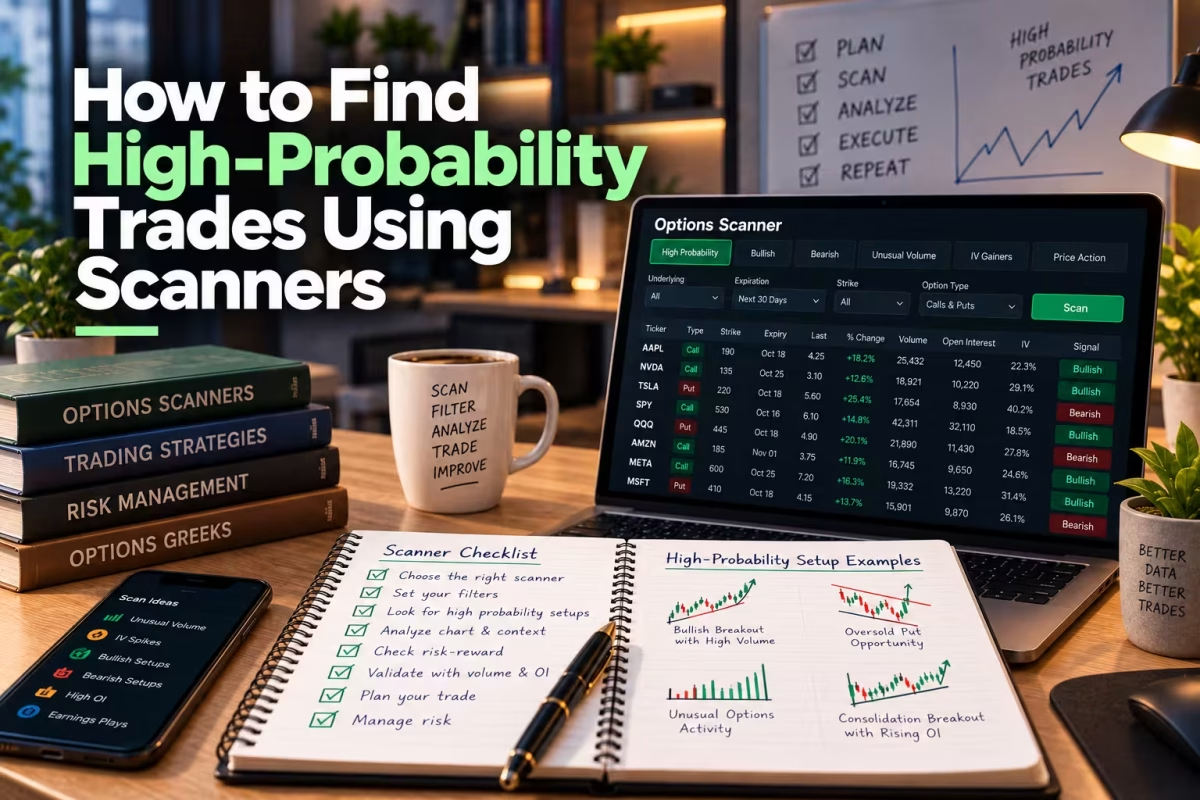
An options scanner can save you hours of digging through hundreds of contracts. But finding a setup and finding a good trade are two different things — and that gap is exactly where most scanner-based strategies fall apart. A solid options scanner strategy doesn’t stop at the alert. It uses the scanner to narrow the field, then applies a consistent process — liquidity, price action, implied volatility, technical confirmation, contract selection, and risk management — to decide whether what the scanner found is actually worth trading.
Quick answer: An options scanner strategy is a rules-based way of using a scanner to filter thousands of contracts down to a short list, then confirming each candidate against the underlying’s price action before you ever look at strike or expiration. The scanner’s job is to reduce how many decisions you have to make — not to make the trading decision for you.
What Is an Options Scanner Strategy?
At its core, an options scanner strategy is a rules-based process for identifying contracts or market conditions that match criteria you’ve already decided matter — volume, open interest, implied volatility, Delta, expiration, price, or unusual activity. Instead of hunting randomly through an options chain, you set the filters first and only investigate the candidates that actually clear them.
Think of the scanner as an idea-generation and filtering tool, not a decision-maker. It can surface a contract that looks great on paper and still be wrong for you — poor liquidity, inflated implied volatility, no technical confirmation, or a risk-to-reward ratio that doesn’t hold up once you look closer.
A practical version of the workflow looks like this: scan the market for potential setups, filter using liquidity and strategy-specific criteria, confirm the underlying with price action and technicals, select the right strike and expiration, define your risk, and only then execute — or reject — the setup based on your own rules. The goal isn’t to find the most active option on the board. It’s to find the option that satisfies your complete setup.
The Three Types of Options Scanners (And When Each One Fits)
Not every scanner is solving the same problem, so it’s worth being specific about what you actually want yours to find.
Criteria-based scanners search using predefined characteristics — Delta, Theta, Gamma, Vega, implied volatility, IV rank, open interest, volume, days to expiration, strike price. These are most useful once you already have a strategy. If you want SPY calls in a particular Delta range with a specific expiration, you don’t need an unusual-flow scanner — you need a criteria-based one.
Unusual activity and options-flow scanners flag large trades, sweeps, blocks, unusual volume, oversized estimated premium, and volume relative to open interest. They’re excellent for generating ideas and spotting where attention is building, but they won’t tell you whether a trade was opened, closed, hedged, or built as one leg of a spread.
Alert-based watchlist scanners monitor a limited group of symbols and notify you when specific conditions trigger. For an SPY and QQQ trader, this can be particularly efficient, since your universe is intentionally small — you’re watching two tickers, not two thousand. That lets you track things like price relative to VWAP, breakouts, volume expansion, options volume, IV shifts, and key support/resistance levels without drowning in noise.
The best scanner is the one that matches your process. A flow scanner is built for finding unusual activity; a criteria-based scanner earns its keep once you already know what characteristics your strategy needs.
Building a High-Probability Options Scan
“High probability” gets thrown around loosely, so it’s worth being precise: no scanner can guarantee a winning trade. What you can build is a setup where several independent conditions all point the same direction — which is a meaningfully different, more honest goal.
Step 1: Start with the underlying, not the option
Before you ever look at a contract, look at SPY or QQQ itself. Is the market trending or ranging? Is price above or below VWAP? Where do the major support and resistance levels sit? Is volume expanding, and is momentum strengthening or weakening? Is there a major economic event on the calendar? Skipping this step is how traders end up falling for an attractive-looking option in a market environment that doesn’t actually support the trade.
Step 2: Apply liquidity filters before anything else
Liquidity is one of the most important — and most commonly ignored — scanner filters. You want adequate options volume, adequate open interest, tight bid-ask spreads, and a contract you can realistically enter and exit. A theoretically great trade becomes a headache to manage if the spread eats your edge before you’re even filled. SPY and QQQ are generally more liquid than most individual-stock options, but that doesn’t mean every strike and expiration on the chain is equally efficient — some corners are still thin.
Step 3: Choose the expiration to match the thesis, not the premium
The wrong question is “which expiration makes this option cheapest?” The right one is “how much time does my thesis actually need to play out?” An intraday momentum idea usually wants same-day or very short-dated options; a short swing might need several days to a few weeks; a bigger directional thesis benefits from more time; premium-selling strategies often run longer than an intraday setup; and an event-driven trade should have its expiration chosen around the catalyst and volatility itself. Short-dated contracts react fast, but that speed comes with real sensitivity to time decay and shifting Delta and Gamma — worth remembering before you reach for the cheapest strike on the board.
From Scanner to Chart: The Confirmation Framework
One of the single biggest upgrades you can make to an options scanner strategy is simply separating discovery from confirmation. The scanner finds the candidate. The chart decides whether that candidate deserves your attention.
Bullish example: Say an SPY scanner flags increasing call volume, strong options liquidity, a concentrated expiration, and rising underlying volume. That’s not a green light to buy a call yet. First check whether SPY is holding above an important support level, trading above VWAP, forming higher highs and higher lows, showing expanding volume during the move, and has room before the next major resistance. If the options signal and the price structure agree, the setup earns a closer look. If SPY is failing resistance and losing VWAP at the same time the scanner lit up, that signal deserves a lot less weight than it first appeared to carry.
Bearish example: QQQ shows unusually high put activity. Before acting, check whether QQQ is below VWAP, whether support has actually broken, whether selling volume is increasing, whether momentum is weakening, and whether the move is showing up across the broader Nasdaq-100 rather than in isolation. You’re looking for confluence — multiple things agreeing — not a reason to confirm what you already wanted to believe.
SPY vs. QQQ: Why One Scanner Setting Doesn’t Fit Both
A single scanner configuration shouldn’t be applied blindly to every underlying you trade. SPY represents broad S&P 500 exposure; QQQ tracks the Nasdaq-100, and Nasdaq itself describes QQQ as one of the principal ETF vehicles providing exposure to that index — 100 of the largest non-financial companies listed on Nasdaq. That structural difference is exactly why QQQ often reacts differently than SPY when growth and technology sentiment shifts.
| Factor | SPY | QQQ |
| Underlying | S&P 500 | Nasdaq-100 |
| Market context | Broad U.S. equity market | Large-cap, technology-heavy growth exposure |
| Useful confirmation | SPY trend, VWAP, breadth, macro levels | QQQ momentum, technology leadership, Nasdaq levels |
| Important catalysts | Fed, CPI, jobs data, broad macro news | Rates, technology earnings, Nasdaq momentum |
| Scanner approach | Emphasize market-wide conditions | Weight momentum and technology-sector context more heavily |
Using the Greeks to Choose the Right Contract
Once the scanner surfaces a candidate, the next question is whether that specific contract actually expresses your thesis efficiently. Delta approximates sensitivity to a move in the underlying; Gamma measures how quickly Delta itself changes; Theta measures sensitivity to time passing; Vega measures sensitivity to implied volatility. Don’t pick a contract just because it shows the highest potential percentage return — work backward instead, from market view, to desired exposure, to the volatility environment, to expiration, to Delta, to risk. An aggressive short-term trader might prefer more Gamma exposure; someone with a longer-duration thesis usually prioritizes extra time to expiration instead.
Implied volatility deserves its own pause here. IV represents the market’s expectation of future price variability, priced directly into the option. A scanner can hand you a contract with attractive directional characteristics that’s simply expensive because IV happens to be elevated right now — which raises a question worth asking every time: is the idea correct, but the option itself poorly priced for the current environment? That’s exactly why contract selection should happen after the underlying thesis is established, not before.
A 7-Point Scanner Checklist Before You Enter
Run through this before acting on anything a scanner flags:
- Market — What is SPY or QQQ actually doing right now? Trending, reversing, or ranging?
- Setup — What caused the scanner to flag this contract in the first place?
- Confirmation — Does price action agree with the signal?
- Contract — Is the strike and expiration appropriate for the thesis?
- Quality — Are liquidity, IV, and the Greeks acceptable?
- Risk — Where is the trade invalidated, and how much capital is on the line?
- Fit — Does this actually match your existing trading rules, or are you bending the rules to fit the alert?
If several of these come back unclear, the scan has still done its job — it found something worth investigating. That’s not the same as finding something worth trading.
Common Scanner Mistakes Worth Avoiding
Chasing the highest volume on the board is a natural instinct, but activity alone isn’t an edge — ask why the volume is elevated and whether the underlying actually confirms it. Piling on dozens of filters can backfire the other way, producing a clean-looking list with almost nothing usable in it; start with the handful of variables that genuinely matter to your strategy and resist the urge to add more.
Bid-ask spreads get ignored more often than they should. A contract can show impressive volume and still carry an inefficient spread that quietly eats your edge — always check the actual quote before entering, not just the headline volume number. Scanner “scores” are another trap: a number is only as good as the methodology behind it, and a score without a visible methodology shouldn’t replace your own judgment.
Cheap out-of-the-money options look tempting precisely because they’re cheap, but low premium doesn’t mean good value — an inexpensive option can carry a genuinely low probability of finishing profitable, especially if the underlying needs a large move before expiration. Time decay compounds this: a trade can be directionally right and still lose money if the underlying doesn’t move fast enough, and that pressure only intensifies as expiration nears. And perhaps the most common mistake of all is letting the scanner override the plan — the scanner should fit your strategy, not the other way around. Your rules shouldn’t change every time a new alert fires.
A Repeatable Daily Workflow for SPY and QQQ Traders
Before the open: review the economic calendar, any major overnight moves, current SPY and QQQ levels, the previous day’s high and low, key support and resistance, expected volatility, and any scheduled catalysts.
During the session: run your scanner for volume expansion, unusual options activity, liquidity, technical breakouts, VWAP conditions, IV changes, and relevant Delta ranges.
Before entry: move from the scanner to the chart and ask whether the underlying confirms the options signal. If yes, examine the contract itself. If no, wait — there’s no rule that says every alert needs a trade attached to it.
After entry: define your stop-loss or technical invalidation level, profit target, maximum acceptable loss, position size, exit conditions, and maximum holding period.
Strung together, that’s a complete process — not a pile of disconnected indicators you’re reacting to one at a time.
Learn Scanner-Based SPY and QQQ Trading with MySpyOptions
A scanner is easiest to use well when it’s treated as one piece of a broader trading system rather than the whole system. MySpyOptions focuses specifically on SPY and QQQ options, combining market analysis, technical concepts, options-strategy education, and live-market learning — with an emphasis on practical trade selection, risk management, strike and expiration selection, and reading price action, rather than leaning on alerts alone.
That distinction tends to matter most for newer traders. A scanner can show you what happened. Working through the reasoning with experienced traders helps you understand why a setup matters, when it’s invalid, and how the option should actually be structured around the thesis — which also tends to reduce the temptation to rewrite your scanner settings or trading rules after every losing trade.
For traders focused specifically on SPY and QQQ, MySpyOptions’ approach is built around SPY- and QQQ-specific market analysis, practical options strategies, live-market examples, technical analysis, contract and expiration selection, position sizing and risk management, and ongoing trader support and mentorship. The goal was never to make you dependent on a scanner or an alert service — it’s to help you learn how to evaluate the setup yourself.
What Actually Makes a Scanner-Based Trade High-Probability?
A scanner can’t make a trade high-probability on its own. A more honest definition: a high-quality scanner setup is one where several independent factors point to the same thesis, and the potential reward justifies the defined risk. Picture it as a chain — scanner signal, then market context, then technical confirmation, then contract selection, then risk control. As an example: QQQ call activity shows up → the broader Nasdaq environment is bullish → QQQ is holding above VWAP → a breakout confirms it → you select a suitable Delta and expiration → you set a predefined stop before entering.
Each link in that chain is handling a different type of uncertainty. The scanner handles discovery. Technical analysis handles timing and market structure. The Greeks and IV help with contract selection. Position sizing handles risk. Put together, that’s the actual purpose of an options scanner strategy — not finding the loudest alert on the screen, but building a repeatable filter for genuinely well-supported setups.
Frequently Asked Questions
What is an options scanner strategy?
An options scanner strategy is a rules-based process for using a scanner to find contracts that match predefined conditions — volume, open interest, implied volatility, Delta, expiration, or unusual activity. Traders then confirm the setup against the underlying’s price action and apply predefined risk-management rules before entering.
How do I find high-probability options trades with a scanner?
Start by defining your strategy and scanning only for conditions that support it. Filter for liquidity, volume, open interest, expiration, and relevant Greeks, then confirm the underlying with price action, VWAP, support and resistance, and volume. Select the contract and define your maximum risk before entering.
What should I scan for when trading SPY and QQQ options?
Volume expansion, unusual options activity, liquidity, implied volatility, Delta, expiration, and technical conditions. Since SPY and QQQ have different underlying exposures, it also helps to weigh broad-market conditions for SPY and Nasdaq-100 or technology-sector momentum for QQQ.
Can an options scanner predict winning trades?
No. A scanner identifies contracts or conditions that meet specific criteria, but options prices are affected by the underlying’s movement, time, implied volatility, and other factors a scanner can’t forecast. It should be used as a filtering and idea-generation tool, not a prediction system.
What is the best way to use an options scanner?
Treat it as the first step in a repeatable process: scan, filter, confirm, select, manage risk. Start with the underlying market, use the scanner to narrow candidates, confirm the setup with technical analysis, choose an appropriate contract, and define the invalidation point before entry.