
Written by the MySpyOptions team — 15+ years trading and teaching SPY and QQQ options, with a community of 1,000+ active traders.
If you’ve spent any real time trading SPY options, you already know the strange part: the exact same setup can behave completely differently depending on when you click the button. A clean breakout at 9:45 AM might hand you a fast 30% gain. Run that same pattern at 12:30 PM and it just… chops. Bleeds your premium. Goes nowhere.
Even your fills change. A contract that triggers instantly in the morning can leave you stuck with a wider bid-ask spread two hours later.
Most traders pour their energy into chart patterns and indicator settings and never once think about the clock. But if you’re asking when to trade SPY, timing isn’t a minor detail — it often matters as much as your entry signal itself.
SPY is one of the most liquid instruments on the planet, and its options market runs on a fairly predictable daily rhythm. Volume spikes and dies down at roughly the same points every session, spreads widen and narrow on a schedule, and real directional conviction tends to show up in the same windows day after day. Understanding SPY intraday trading time patterns is genuinely one of the higher-leverage things you can learn as an options trader — and it costs nothing to apply once you know it.
Quick Answer
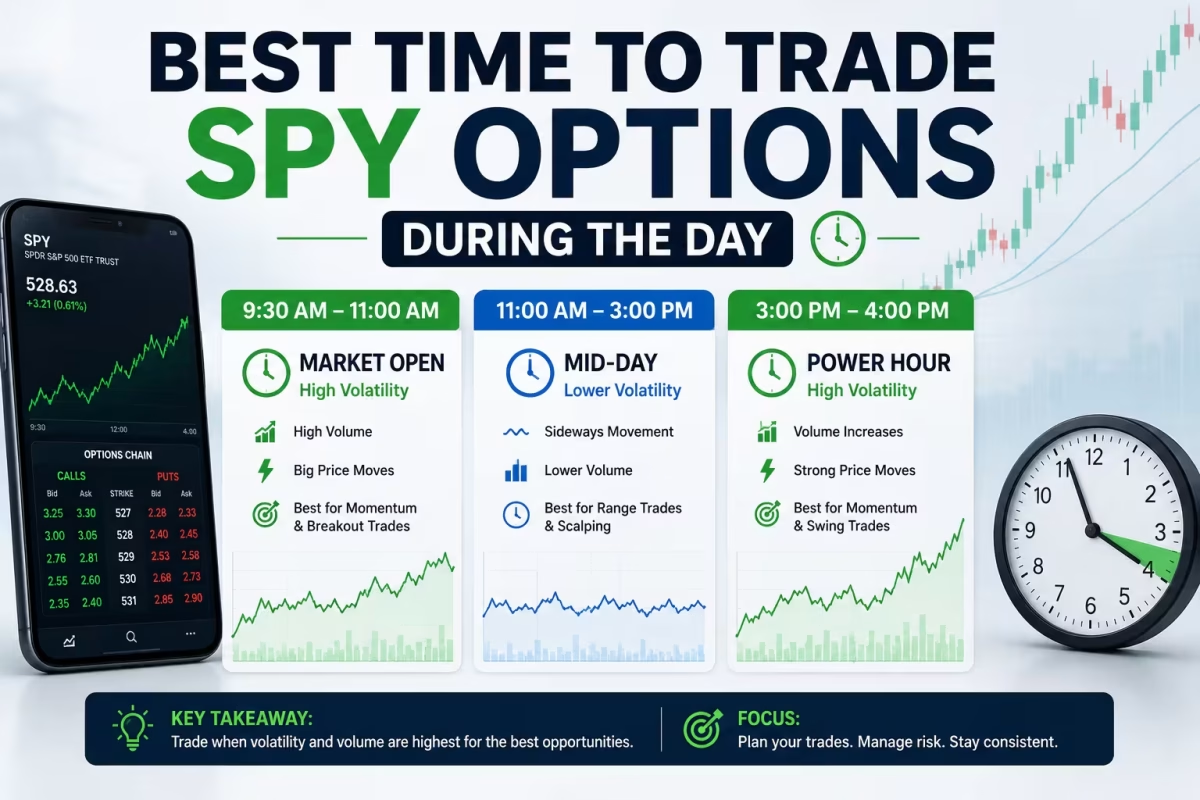
The best time to trade SPY options is generally the first 60–90 minutes after the open (9:30–11:00 AM ET) and the final hour before the close (3:00–4:00 PM ET). These two windows consistently bring the heaviest institutional volume, the tightest spreads, and the cleanest directional price action.
That doesn’t mean the middle of the day is dead money for everyone — but the market’s internal mechanics shift hard as the session goes on, and that shift directly changes how your options get priced and filled.
Why Timing Moves the Needle: 4 Forces at Work
- Liquidity. This is just how easily you can get in and out without paying up for it. SPY options are liquid overall, but that liquidity isn’t flat across the day — it surges when big players are active and thins out when they step back. When it’s high, you get near-instant fills, penny-wide spreads, and minimal slippage. Losing two cents on entry and exit doesn’t sound like much on one contract, but multiply that across a few hundred trades a year and it’s a real drag on your edge.
- Volatility. This is the engine behind your profit potential — and your risk. The open typically brings the day’s sharpest volatility, since overnight news, global market moves, and institutional rebalancing all collide at once. Scheduled catalysts like CPI prints, jobs reports, and FOMC decisions can also spike volatility well outside the open. Volatility itself isn’t good or bad — it’s a tool. The goal is trading when it works with your setup, not fighting a market that’s simply drifting.
- Time decay (Theta). Premiums erode as expiration approaches, and for 0DTE or near-expiration contracts, that erosion accelerates hour by hour. Hold a short-dated contract through a slow, directionless stretch and you can watch value disappear even while SPY itself barely moves.
- Institutional participation. Big funds and algorithmic desks drive most of SPY’s volume, and their activity clusters heavily around the open, scheduled data releases, and the close. Knowing when that participation peaks helps you find the windows with real directional conviction instead of noise.
None of this is a niche phenomenon anymore, either. Same-day expiration trading has become a much larger share of the tape than it was even a couple of years ago — Cboe reported that SPX 0DTE contract volume climbed more than 46% year-to-date in Q2 2026 to over 20 million contracts a day, and ETF options volume overall is running near 28 million contracts daily. When that much same-day and short-dated flow is competing for fills in a handful of narrow windows, the gap between trading during peak hours and trading during the midday lull only gets wider. (Source: Cboe Global Markets, State of the Options Industry, Q2 2026)
How the SPY Session Actually Unfolds
| Time (ET) | What’s Happening | Best Suited For |
| 9:30 – 9:45 AM | Opening chaos — huge volume, wild swings, wide initial ranges | Experienced scalpers, tape readers |
| 9:45 – 11:00 AM | The “sweet spot” — volume stays high, moves start to follow through cleanly | Most intraday traders |
| 11:00 AM – 2:00 PM | The midday lull — volume dries up, price drifts, Theta keeps ticking | Best used for research, not entries |
| 2:00 – 3:00 PM | Afternoon wake-up — volume and conviction start rebuilding | Trend and breakout traders |
| 3:00 – 4:00 PM | Power Hour — index rebalancing, closing auctions, decisive moves | Trend followers, 0DTE traders managing risk tightly |
Illustrative pattern of relative SPY trading volume by hour — volume peaks at the open and into Power Hour, and bottoms out during the midday lull.
9:30–9:45 AM: The Opening Bell Chaos
The first 15 minutes are mostly noise. Overnight headlines, economic data, and global market moves all get priced in at once, producing deep liquidity but also fast reversals. Picture SPY gapping up a full percent on a strong jobs report — retail buys calls right at the bell, and five minutes later institutional desks unload overnight longs into that strength, and the move reverses. Waiting even ten minutes for that initial surge to settle has saved a lot of traders from buying the top.
9:45–11:00 AM: The Real Window
This is where institutional footprints actually become visible. The wild opening whipsaws smooth out, and price starts respecting levels that matter — VWAP, key moving averages, prior day highs and lows. You’re no longer guessing whether a level will hold; you can actually watch it get tested. High liquidity without the 9:30 randomness, cleaner chart structure, and more predictable option pricing all show up here.
11:00 AM–2:00 PM: The Chop Zone
Wall Street effectively goes to lunch. Volume falls off, and SPY tends to drift in a tight, frustrating range. This window is genuinely dangerous for 0DTE or short-dated contracts — Theta keeps grinding down your premium even while the underlying barely twitches. The classic beginner mistake here is forcing a trade out of boredom. Recognizing that sitting out is itself a decision — and often the correct one — will save more capital over a trading career than almost any indicator will.
2:00–3:00 PM: The Afternoon Reset
Institutional rebalancing starts picking back up, volume creeps in, and breakouts start holding better than they did an hour earlier. Late-day Fed speakers or economic releases often land in this window too, acting as a warm-up for the final hour.
3:00–4:00 PM: Power Hour
The last 60 minutes tend to be the most electric stretch of the day. Between index rebalancing, closing auctions, and 0DTE traders fighting over gamma levels, SPY usually makes a decisive move into the bell. Watch VWAP holds or rejections, volume spikes on 5-minute candles, and breaks past the midday range — but keep risk tight, because the same energy that produces the biggest late-day gains can wipe out a contract just as fast if you’re on the wrong side.
Matching Your Strategy to the Market’s Mood
Rather than mechanically trading the same hour every day, it helps to match your window to the actual conditions in front of you:
| Market Condition | Best Window | Strategy Focus |
| Strong directional trend | 9:45 – 11:00 AM | Buying pullbacks to VWAP / 9 EMA |
| Gap up or down at the open | 9:45 – 10:30 AM | Opening range breakouts |
| Choppy, sideways session | Wait until 2:00 PM+ | Afternoon range breaks |
| High implied volatility | 9:30 – 10:30 AM | Quick momentum scalps |
| Low volatility / tight compression | 3:00 – 4:00 PM | Power Hour trend continuation |
Before you actually place the trade, run through a quick confluence check: Is price clearly above or below VWAP? Is relative volume expanding on the move, or is it a low-volume drift? Does RSI agree with the direction, or are you seeing divergence? Are your short- and medium-term moving averages actually stacked in favor of the trade? And can you realistically get 2:1 before hitting the next major support or resistance level? If most of those don’t line up, that’s usually your answer.
0DTE vs. Weekly Contracts: Timing Isn’t the Same for Both
0DTEs are hyper-sensitive to the clock because Delta, Gamma, and Theta are all moving at maximum speed. A $0.50 move in SPY can swing a same-day contract’s value by 30% or more. For 0DTE and scalping setups, stay disciplined about sticking to the 9:45–11:00 AM and 3:00–4:00 PM windows — taking these trades during the midday chop is one of the fastest ways to watch decay eat a contract while SPY goes nowhere.
Weekly contracts (3–7 days to expiration) decay much more slowly, which buys you room to be patient. Traders running straddle or strangle setups or comparing a call vs. put approach on weeklies often find better entries on late-morning pullbacks or afternoon retests, once the opening noise has cleared.
Five Mistakes That Quietly Burn SPY Traders
- Buying right at the 9:30 open. You’re stepping into the widest spreads and the highest odds of an institutional fakeout of the day.
- Ignoring the bid-ask spread. Even SPY spreads widen once volume drops — that slippage adds up fast during quiet stretches.
- Trying to catch tops and bottoms. Fighting a clear intraday trend without real confirmation is usually a full-loss trade waiting to happen.
- Trading out of boredom between 11:30 AM and 1:30 PM. Knowing when not to trade is arguably a bigger skill than knowing when to.
- Ignoring the economic calendar. CPI prints, jobs reports, and FOMC minutes can move SPY sharply with little warning — always check what’s scheduled before you size a position.
Pre-Trade Checklist
- Trend direction confirmed across more than one timeframe
- Economic calendar checked for scheduled releases
- Spreads are tight and liquidity looks clean on the contract you’re using
- Entry, stop-loss, and target are mapped out before the order goes in
- Risk-to-reward meets your baseline (2:1 minimum is a reasonable floor)
- Position size is calibrated to what you can lose, not how confident you feel
FAQs
What is the best time to trade SPY options during the day? The strongest window is generally 9:45–11:00 AM ET, once the initial opening noise has settled but liquidity and momentum are still strong. The final hour, 3:00–4:00 PM ET, is the second major window, driven by institutional rebalancing and closing auctions.
Is it better to trade SPY options in the morning or afternoon? It depends on your style. Morning (9:45–11:00 AM ET) tends to suit scalpers and momentum traders looking for high-volume breakouts. Afternoon (2:00–4:00 PM ET) suits traders who prefer trend continuations and late-day VWAP setups. Most experienced traders simply sit out the middle of the day rather than force something in slow conditions.
Why should traders avoid SPY options during midday? Between roughly 11:30 AM and 2:00 PM ET, volume drops sharply and SPY tends to drift in a tight range. For short-dated or 0DTE contracts, this is where Theta decay does the most damage relative to how little the underlying actually moves.
Which indicators work best when trading SPY options? VWAP for tracking where institutional orders are anchored, EMA alignment (9 and 20) for short-term trend confirmation, RSI and MACD for momentum and exhaustion signals, and Volume Profile for identifying real support and resistance built from actual traded volume. No single indicator is a magic signal — using a few together in confluence is what filters out weak setups.
Does the ideal trading time change for 0DTE SPY options? Yes, and the margin for error shrinks considerably. Because 0DTE contracts carry extreme Delta, Gamma, and Theta sensitivity, poor timing shows up in your P&L almost immediately. Sticking to the first hour after the open or the final hour before the close matters even more here than it does for weekly or monthly contracts.
How can beginners get better at timing SPY options trades? Limit execution to the high-liquidity windows described above, map your entry, stop, and target before placing the order, risk a small fixed percentage of your account per trade, keep a trade log, and practice in a simulator until the process feels mechanical rather than emotional. Structured weekly options strategies can also be a lower-pressure way to build these habits before moving into faster 0DTE setups.
Final Thoughts
It’s easy to get absorbed in chart patterns and indicator settings and forget the clock entirely. But running a solid setup during the wrong part of the session is one of the more common ways a good strategy turns into a losing one.
For most retail accounts, 9:45–11:00 AM ET offers the best mix of tight spreads, real volume, and follow-through. Power Hour offers a second wave of opportunity for traders who know how to read institutional flow near the close. And just as important as knowing when to trade is knowing when not to — the midday chop has quietly cost more traders money than almost any bad indicator setting ever has.
Timing is only one part of a durable process, though. Reading price action, managing the Greeks under pressure, and keeping emotion out of your risk decisions all matter just as much. At MySpyOptions, we build our training around exactly that — a rules-based approach to SPY and QQQ options rooted in VWAP dynamics, volume profile, and disciplined risk management, rather than signals or guesswork. You can browse more strategy breakdowns, including on gamma squeezes and other options mechanics, on our blog.
Trading options involves substantial risk and isn’t suitable for every investor. This article is for educational purposes only and isn’t personalized investment advice — see our full disclaimer for details.